stud
bud
Sign up
Log in
Home
Library
Explore
SAT
More
Duplicate of Biology: Classification Review Flashcards | StudBud
Explore
/
Duplicate of Biology: Classification Review
Duplicate of Biology: Classification Review
53 terms
·
StudBud Administration
·
464 plays
#biology #highschool #taxonomy #classification
Flashcards
53 cards
F
Practice quiz
P
Host live
L
Questions
53
Answers
1
The parts of binomial nomenclature are the
genus and phylum
genus and species
family and species
kingdom and domain
2
What is the genus?
carolinensis
Anolis
3
What is the derived character in the chimpanzee?
lungs
fur and mammary glands
claws or nails
opposable thumbs
4
The Domains are Bacteria, Archaea, and
Fungi
Plants
Animals
Eukarya
5
What is the species?
Porcellio
scaber
6
A classification system that uses derived and shared characters to group organisms is
a pictogram
a differential diagram
a mammogram
a cladogram
7
Homo habilis, Homo erectus, and Home sapiens all belong to the same ____________.
class
family
species
genus
8
We use binomial nomenclature because
it avoids confusion between scientists
you can name something after yourself
it tells where something was discovered
9
Protists are unique because they
can only live on land
not plant, animal or fungus
are very small
are very large
10
Binomial nomenclature uses all _ words.
Latin
Greek
French
English
11
The DNA sequences of two species of sharks would:
be very close to the DNA sequences of a dolphin.
be more similar than the DNA sequences of a shark and a dolp
show no discernible differences.
indicate how sharks evolved.
12
Four of the kingdoms include eukaryotes and the other two include _____________.
prokaryotes
animals
fungi
plants
13
Which animal is most closely related to the primate in this cladogram?
rodents and rabbits
birds
crocodiles
amphibians
14
The largest group in classification is
phylum
domain
class
kingdom
15
Which animal is most closely related to the shark?
amphibians
ray finned fish
primates
crocodiles
16
If handwritten, the genus in binomial nomenclature is written _ .
with a capital letter and underlined
with a lower case letter and underlined
italicized
without underlining it
17
The science of naming, describing, and classifying organisms.
taxonomy
homologous
hybrid
organization
18
Linnaeus' naming system is based on
form and structure
protein mutations
science
age of an organism
19
Which groups listed are included in a kingdom?
class, domain, family
domain only
phylum, class, species
20
How many Domains are there?
2
5
3
6
21
What is a shared character in the lizard, hamster and chimpanzee?
claws or nails
fur and mammary glands
lungs
opposable thumbs
22
Plants, animals, protists and fungi are all included n Domain Eukarya because they are all
mammals
prokaryotes
eukaryotes
zygotes
23
Which groups listed would be included in a family?
genus and species
phylum, class & order
domain, kingdom, phylum
class and order
24
Feature that evolved only within a particular taxonomic group.
Shared character
Species
Cladogram
Derived character
25
A group of organisms that can mate and produce fertile offspring.
species
genus
family
kingdom
26
If typing a scientific name, you must do which of the following?
capitalize first letter of the species
upper case for species
upper case letter for species
type in italics
27
These organisms have a cell wall made of chitin and digest food outside of their cells.
plants
protists
fungi
animals
28
Which of these groups contains organisms that are the most unique?
species
phylum
family
genus
29
Linnaeus' smallest group is the
order
phylum
genus
species
30
What is the shared character in all clades?
eggs with shells
four limbs
vertebrae
bony skeleton
31
A model that shows how related organisms are to each other is called a
concept map
Punnett square
homologous structure
phylogenetic tree
32
What is the LARGEST group in which would you find plants, animals protists and fungi?
Phylum
Domain
Class
Kingdom
33
Scientists use visible similarities to classify as well as using
diagrams
homologous chromosomes
food the animal eats
fossils, embryos, DNA
34
Which characteristic is shared by all groups in the picture?
fishes
watertight egg
backbone
four limbs
35
These organisms have cell wall of cellulose, photosynthesize, central vacuole.
plants
protists
fungi
animals
36
What is the genus of this bird?
Northern Cardinal
Cardinalis
cardinalis
37
Quercus rubra : Quercus phellos ::
Erithacus rubicula : Turdus migratoria
Aphis pomi : Aphis gossypii
Anolis carolinensis : Parus carolinensis
carp : goldfish
38
Kingdom made of one-celled, eukaryotic organisms that aren’t plants, animals, or fungi.
Plantae
Protista
Fungi
Animalia
39
What trait is derived in the primates and rabbits?
four limbs
hair
eggs with shells
amniotic egg
40
Who invented the current naming system in science?
Mendel
Aristotle
Galileo
Linnaeus
41
An ancient prokaryote engulfed a smaller prokaryote and they began to live as one cell.
endosymbiosis
homozygosis
morphosis
exocytosis
42
Heterotrophic, have no cell wall, have a nervous system, and move on their own
plants
fungi
protists
animals
43
Domain made of prokaryotes that can live in extreme environments.
Eukarya
Archaea
Bacteria
44
In the picture, which character is derived in mammals and reptiles?
none of these
four limbs
backbone
watertight egg
45
Features that members of a group all have in common is called
a shared characteristic
a derived characteristic
46
Linnaeus’s system of classification had _____ kingdoms.
3
1
4
2
47
If handwritten, the species name is written _.
italicized
lower case and underlined
without being underlined
upper case and underlined
48
The modern system of classification has ____ kingdoms.
3
4
6
5
49
Which group would be included in a genus?
domain
species
phylum
family
50
A two name naming system is called
homologous pairs
taxonomy
binomial nomenclature
double names
51
In which language are scientific names written?
English
Greek
Arabic
Latin
52
A feature that evolved only in a certain group is a
derived character
shared character
53
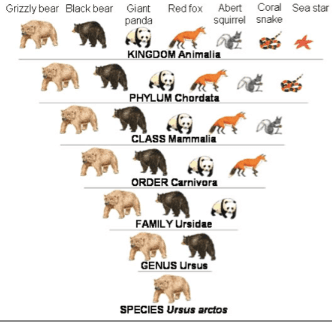
Inside a Domain, what is the order of classification from largest to smallest?
phylum, kingdom, order, class, genus, family, species
species, genus, family, order, class, phylum, kingdom
genus, species, family, order, phylum, class, kingdom
kingdom, phylum, class, order, family, genus, species