stud
bud
Sign up
Log in
Home
Library
Explore
SAT
More
The Renaissance Flashcards | StudBud
Explore
/
The Renaissance
The Renaissance
43 terms
·
StudBud Administration
·
12 plays
Imported from external platform
Flashcards
43 cards
F
Practice quiz
P
Host live
L
Questions
43
Answers
1
Natural backgrounds with depth, active figures with emotion, and shading describe ______ art.
Medieval
Renaissance
Classical
2
The main cause for the Renaissance was the growth of
trade
feudalism
the Catholic Church
Germanic kingdoms
3
The founder of humanism was
Medici
da Vinci
Petrarch
Dante
4
Donatello and Michelangelo's sculptures of David were all of the following
EXCEPT
realistic
freestanding
emotionless
Biblical
5
Florence was known for its wool and
armor
ivory
banking
gold
6
Where did the Renaissance begin?
Germany
France
Italy
Greece
7
Solid backgrounds, religious themes, and stiff figures without emotions describe ________ art.
Classical
Renaissance
Medieval
8
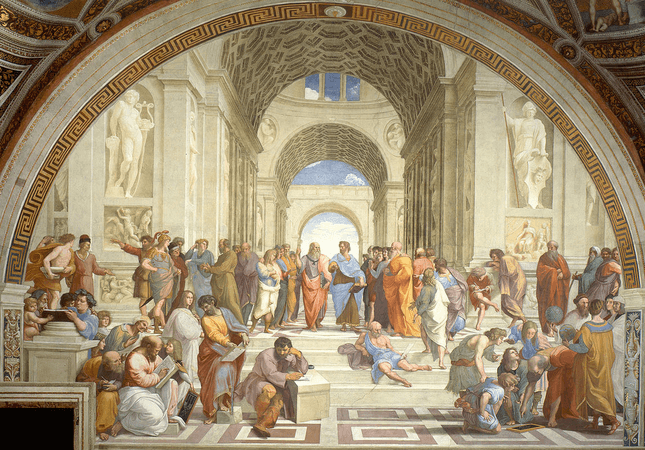
Renaissance artists like Raphael discovered that shading and a vanishing point gave paintings
a flat perspective
realistic emotion
action and motion
three-dimensional depth
9
Wealthy merchants and bankers supported education in their city-states by
commissioning art
creating new banks
teaching Latin
establishing universities
10
Renaissance is a French word meaning
rebirth
trade
death
art
11
Leonardo da Vinci's notebooks include drawings of all of the following
EXCEPT
flying machines
weapons
maps from an aerial view
automobiles
12
Mercato Vecchio and Mercato Nuovo became important centers of
politics
art
trade
education
13
Machiavelli's book
The Prince
presented the authors observations and beliefs about
art
education
religion
government
14
Dante's
Divine Comedy
, his imaginary journey through the afterlife, was
full of real characters
unemotional
only written in Latin
15
Craftspeople became more important because they
made goods merchants sold
bought luxuries
loaned money to merchants
exchanged currencies
16
Idealized figures in the nude performing heroic tasks describe _______ art.
Renaissance
Classical
Medieval
17
The most powerful people of a city-state were the
church leaders
craftspeople
rich merchants and boards
soldiers
18
The thinkers of the Renaissance imitated and __________ Classical ideas of art and learning.
took credit for
improved
made fun of
discouraged
19
Galileo used a telescope to discover
moon spots
saturn's rings
the moons of Jupiter
the sun
20
Humanism's emphasis on individualism especially challenged medieval views on
community
trade
social classes
baptism
21
Palazzi is a
bank
cathedral in the town square
palace with a courtyard
government building
22
A new economy of bankers developed because traders began
giving away belongings
writing checks
using coins
bartering
23
The most powerful family in Florence were the
Medicis
Romans
Machiavellis
Palazzis
24
What invention increased communication, learning, and literacy?
submarine
paper
mechanical clock
printing press
25
The Renaissance spread throughout northern Europe because city-states
were religious
were run by the army
grew wealthy
began trading
26
City-states were empowered by all of the following
EXCEPT
collecting own taxes
conducting own trade
making own laws
creating own religion
27
Vesalius's study of ____________ changed the field of medicine.
diseases
astronomy
human anatomy
mental illness
28
Cervantes's
Don Quixote
was a __________ story.
political
serious
sad
funny
29
All of the following are causes of the Renaissance
EXCEPT
goods and ideas brought back by Crusaders
church power grew when the pope relocated
classical works copied by Muslim scholars
traders and travelers brought back classical learning
30
Copernicus advanced astronomy with his daring theory of
a heliocentric universe
geometry
gravity
algebra
31
What did Queen Isabella and Queen Elizabeth have in common?
They promoted exploration
The wrote novels.
They were scientists.
They married wealthy princes
32
The Renaissance was a rediscovery of the art and learning of ancient
China
Greece and Rome
India
Mesopotamia
33
What is Shakespeare known for?
his plays
his scientific discoveries
his political novels
his sketch books
34
The Renaissance was "birthed" in Florence because of its
closeness to the Pope
immaturity
location
isolation
35
Galileo and other Renaissance scientists emphasized ________ and _________.
tradition, acceptance
observation, experimentation
laws, war
Latin, Greek
36
The way of thinking that balanced faith with an emphasis on individual dignity and nature was
Latin
Popism
humanism
Renaissancism
37
Humanities are subjects that focus on human life and culture such as poetry and
anatomy
astronomy
history
mathematics
38
Florence was the ideal city to birth a Renaissance because of its
military
metalworking
religion
wealth
39
Brunelleschi is known as the architect of Santa Maria del Fiore's great
dome
stonework
buttresses
arches
40
Patrons are people who
serve the Pope
organize trade markets
support and commission art
sell luxuries
41
Which geographical factor helped Florence become a wealthy city?
Appenine Mountains
Swiss Alps
Arno River
Northern European Plain
42
Artists traveled to Italy to
practice their sailing
get money from patrons
teach Italian students
learn new techniques
43
Humanism challenged the Catholic Church by encouraging people to
take the sacraments
obey
ask questions
participate in the Crusades