stud
bud
Sign up
Log in
Home
Library
Explore
SAT
More
Our Solar System Flashcards | StudBud
Explore
/
Our Solar System
Our Solar System
17 terms
·
StudBud Administration
·
1,074 plays
A quiz about planet and star characteristics
Flashcards
17 cards
F
Practice quiz
P
Host live
L
Questions
17
Answers
1
Which of the following planets is known for rotating on its side?
Neptune
Jupiter
Uranus
Venus
2
Meteors are made of...
Rock or gas
Rock or metal
Ice
3
Comets are made of ______________ and orbits around ______________
rock, Earth
rock, the Sun
ice, Earth
ice, the Sun
4
Which of the following is correct about Venus?
Brightest object in the night sky
Very dry land
Is very cold
The smallest planet
5
Which is larger?
Stars
Planets
6
Which color of star is the hottest?
Orange
Blue
Red
yellow
7
Jupiter, Saturn, Uranus, and Neptune are known as the...
Terrestrial planets
Inner planets
Gas giants
8
Which is closer to us?
Planets
Stars
9
The two types of planets are...
Terrestrial and Aquatic
Gas Giants and Terrestrial
Aquatic and Gas Giants
10
Which of the following is correct about Jupiter?
The coldest planet
Slow rotation
Has a huge hurricane so is very windy
The smallest planet
11
The light year is a measure of...
Distance
a star's life
Speed
Time
12
Which of the following planets has a great dark spot, some thin rings, and at least 8 moons?
Mercury
Neptune
Mars
Jupiter
13
Which of the following is correct about Mercury?
All answers are correct
Has no atmosphere
Very hot or very cold
It is the smallest planet
14
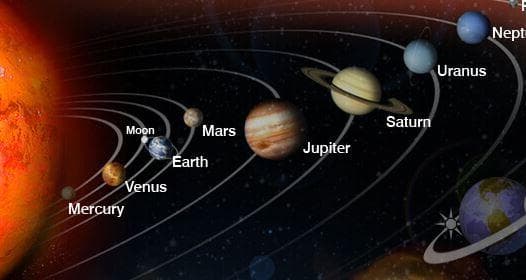
The correct order of the planets from the sun is...
Mercury-Venus-Earth-Mars-Jupiter-Saturn-Uranus-Neptune
Mercury-Venus-Mars-Earth-Saturn-Jupiter-Uranus-Neptune
Mercury-Mars-Venus-Earth-Saturn-Jupiter-Neptune-Uranus
15
Which of the following is correct about Saturn?
Is classified as a terrestrial planet
Rotates quickly so has high winds
Is the only planet with rings
Has no moons
16
Meteorites are...
Similar to comets
Meteors that hit Earth
In a "belt" between Jupiter and Saturn
The same size as asteroids
17
Some planets can be seen in the sky without a telescope because...
They reflect light from the Sun
They are really big
They produce their own light
They twinkle