stud
bud
Sign up
Log in
Home
Library
Explore
SAT
More
Ch. 19 Review - History of life Flashcards | StudBud
Explore
/
Ch. 19 Review - History of life
Ch. 19 Review - History of life
30 terms
·
StudBud Administration
·
1,350 plays
Imported from external platform
Flashcards
30 cards
F
Practice quiz
P
Host live
L
Questions
30
Answers
1
Fossils can form under
volcanic rocks only
Lots of conditions
only very specifc conditions
2
Which of the following is NOT evidence of endosymbiosis?
both mitochondria and chloroplasts have double membranes
bacteria eat other cells all the time
Mitochondria and chloroplasts both have their own DNA
mitochondria and chloroplasts divide like bacteria
3
Radiometric dating uses ____________________ to figure absolute ages.
radioactive-life
half-life
earth-life
short-life
4
What type of rocks are fossils usually found in?
Metamorphic
sedimentary
lunar
volcanic
5
Index fossils are used to
date sedimentary rock layers
date volcanic rock layers
date metamorphic rocks
date igneous rocks
6
What type of organic molecules did the Miller and Urey experiment create.
Amino acids
Simple Carbohydrates
Nucleic acids
Lipids
7
What type of organism is found in the earliest known fossils?
dinosaurs
bacteria
trilobites
plants
8
Cyanobacteria are
extinct bacteria
all are correct
photosynthetic bacteria
disease causing bacteria
9
Old rocks can be age dated by using radioactive isotopes with a __________ half life.
long
short
triple
10
Which of these characters reminds you most of Mr. S?
Patrick Stewart
Uncle Fester
Walter White
Bruce Willis
11
True or False: Earth's early atmosphere contained oxygen.
False
True
12
A fossil that is easily identified, widely found, and short lived is
proof that life was abundant during that time period.
called a primary fossil
called a index fossil
called a secondary fossil.
13
Earth's oceans turned from brown to blue after what process evolved?
respiration
sexual reproduction
photosynthesis
multicellularity
14
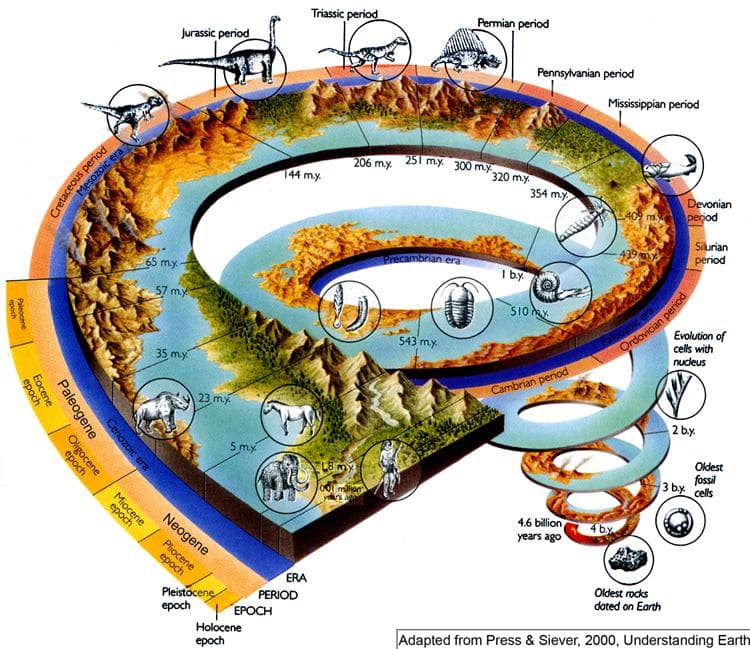
Which of the following spans the smallest amount of time; Era, Period, or Eon?
Era
Eon
Period
15
What fraction of the original radioactive isotope is left after 3 half lives?
1/8
3/4
1/2
1/4
16
Bones found around an ancient burial ground would most likely be radiometric dated using
carbon 14
uranium 238
nitrogen 14
potassium 40
17
Which of the following information can fossils provide paleontologists?
organisms way of life
organism structure
organisms environment
all of them are correct
18
True or False: The early earth lacked oceans because it was too warm.
True
False
19
True or False: Geologic forces on earth have caused changes in earth's living organisms.
False
True
20
Which of these cartoon characters reminds you most of Mr. S?
Elmer Fudd
Stick Figure
Ziggy
Charlie Brown
21
Some divisions of the geologic time scale are because of
radioactive decay of the earth
dinosaurs evolving to fly
periods of earthquakes
mountain building
22
True or False: Life on earth has caused changes in earth's physical environment.
True
False
23
Using the time scale below, calculate how long the Paleozoic Era lasted.
66 million yrs.
240 million yrs.
330 million yrs.
570 million yrs.
24
Half-life refers to the
time needed for half the radioactive isotope to decay.
time needed for half the atoms to double.
time needed for half of all atoms to decay.
time needed for half of a samples mass to disappear.
25
True or False: One Hypothesis states that DNA came before RNA
True
False
26
Some divisions of the geologic time scale are because of
the changing seasons
insects evolving to fly
flooding
global warming
27
What geologic process causes the same fossil to appear on continents thousand of miles apart?
Mountain building
Volcanic eruptions
Erosion
Plate tectonics
28
Some divisions of the geologic time scale are because of
radioactive decay of the earth
forest fires
mass extinctions
periods of earthquakes
29
What process allows BACTERIA to change, or increase diversity?
DNA mutations
ribosomes mutations
binary fission
fertilization (sexual reproduction)
30
Which of the following spans the largest amount of time; Era, Period, or Eon?
Period
Eon
Era