stud
bud
Sign up
Log in
Home
Library
Explore
SAT
More
Periodic Table, Elements, and Radioactivity Review Flashcards | StudBud
Explore
/
Periodic Table, Elements, and Radioactivity Review
Periodic Table, Elements, and Radioactivity Review
40 terms
·
StudBud Administration
·
314 plays
review of elements and periodic table structure #periodictable
Flashcards
40 cards
F
Practice quiz
P
Host live
L
Questions
40
Answers
1
How did chemists change Mendeleev's periodic table?
They included physical properties like density.
The used atomic number instead of atomic mass.
They used atomic mass instead of atomic number.
The included chemical properties like bonding power.
2
How many neutrons does a -1 Fluorine-19 ion have?
9
10
11
19
3
During radioactive decay, atomic nuclei of unstable isotopes _____.
give off nuclear radiation
are broken down by radioactive bacteria
form chemical bonds
are unchanged
4
Which of the following is NOT a property common to non-metals?
brittle
dull
reactive with other elements
conduct electricity easily
5
How many valence electrons does Phosphorus (P) have?
1
15
3
5
6
Mendeleev created the first periodic table by arranging the elements in order of _____.
increasing melting points and densities
decreasing atomic mass
increasing atomic number
increasing atomic mass
7
Which of the following statements about metals is true?
Metals need to be stored in sealed containers for safety
Metals show a wide range of chemical properties
Metals do not react with oxygen
Metals are highly reactive
8
In the periodic table, the most reactive elements are found in _____.
Groups 13-16 in the center
Period 1, the first row on the top
Group 1, the first column on left
Periods 6 & 7 at the bottom
9
What natural event provides enough energy to create elements heavier than iron?
a particle accelerator
a supernova
a plasma
a nebula
10
What is a half-life (in science)?
waves given off by radioactive material
half of an element
the amount of time for half a radioactive sample to decay
a video game
11
A piece of paper will provide protection from _____.
gamma radiation
beta radiation
gamma rays
alpha radiation
12
How many valence electrons does the element Oxygen have
6
16
8
15
13
What is an isotope?
an atom with a different number of electrons than protons
an atom with a different number of neutrons than its protons
an atom with a different number of protons than its neutrons
an atom with different numbers of neutrons and electrons
14
Fluorine, chlorine, bromine and iodine are part of a family called _____.
metalloids
alkali metals
halogens
noble gases
15
Sodium has 11 protons, 12 neutrons and 11 electrons. What is it's atomic number?
12
22
23
11
16
What is unique about noble gases?
exist as solid elements
form salts
Don't form compounds
Are non-reactive
17
The elements that do not ordinarily form compounds are ______.
elements in the carbon family
halogens
noble gases
metals
18
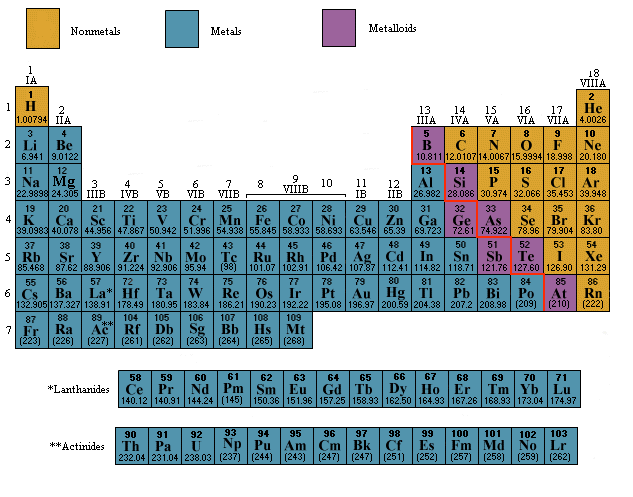
Which group of elements share characteristics with both metals and non-metals?
lanthanides
halogens
metalloids
salts
19
Which element in the Alkaline Earth Metals would have 2 electrons in the 4th electron shell?
Calcium
Barium
Beryllium
Strontium
20
What is the heaviest element that our sun would be capable of producing during its existence?
Oxygen
Carbon
Helium
Iron
21
Why would it be difficult to determine the properties of a new synthetic element?
The element would not fit in the periodic table
The element's nuclei would break apart very quickly
The element would lack properties of ordinary elements
The element would combine the properties of the nuclei
22
Which of the following statements about transition metals is true?
They are never found uncombined in nature
They are the most reactive of all types of metals
They include metals such as gold, silver and copper
They are so soft they can be cut with a knife
23
What is the difference between atomic mass and mass number?
mass number = average mass, atomic mass = total mass
they are basically the same
atomic mass = protons, mass number = total mass
atomic mass = average mass, mass number = total mass
24
What British scientist discovered that the elements could be arranged by atomic number?
Rutherford
Thompson
Einstein
Moseley
25
If an atom has 15 electrons, how many protons will it have?
20
15
0
30
26
What is the most reactive Alkali Metal?
Francium
Lithium
Cesium
Potassium
27
The sun is made of mostly what element?
carbon
hydrogen
iron
oxygen
28
The elements in a column of the periodic table ____.
have the same atomic mass
are in the same period
have similar properties
have similar chemical symbols
29
This highly reactive family includes Fluorine, Bromine, and Iodine.
Noble Gases
Halogens
Alkali Metals
Transition Metals
30
The Lanthanide Series of elements are a part of what period?
6
7
5
8
31
This element is in period 5 and group 16.
Antimony (Sb)
Selenium (Se)
Thallium (Tl)
Tellurium (Te)
32
Sodium has 11 protons, 12 neutrons and 11 electrons. What is it's mass number?
23
11
12
22
33
Which number represents the atomic mass of Sodium?
22
22.99
11
23
34
What information in the periodic table indicates the number of protons in an atom?
the position of the element in the column
the element's atomic mass
the element's atomic number
the element's chemical symbol
35
Which group contains the most elements?
metalloids
non-metals
metals
transition elements
36
What process provides the immense energy released by the sun?
exothermic chemical reaction
nuclear fission reaction
combustion reaction
nuclear fusion reaction
37
How many electrons would a +2 ion of Calcium have?
22
18
20
40
38
How does the atomic mass of the elements change as you move from top to bottom on the table?
Stays the same
Mass increases
Mass decreases
39
Which answer best describes Alpha decay?
nucleus loses 2 protons, 2 neutrons, and releases radiation
nucleus gains 2 protons, 2 neutrons, and releases radiation
a neutron changes to a proton and releases an electron
a proton changes to a neutron and releases an electron
40
A material is ductile if it _____.
can be pulled or drawn into a long wire
can transfer heat or electricity to another metal
is a mixture of metal with at least one other element
can be hammered or rolled into flat sheets