stud
bud
Sign up
Log in
Home
Library
Explore
SAT
More
Theory of Plate Tectonics (ch. 4) Flashcards | StudBud
Explore
/
Theory of Plate Tectonics (ch. 4)
Theory of Plate Tectonics (ch. 4)
25 terms
·
StudBud Administration
·
349 plays
Plate Tectonics Review Quiz
Flashcards
25 cards
F
Practice quiz
P
Host live
L
Questions
25
Answers
1
Who was the scientist that developed the theory of Continental Drift?
Albert Einstein
Alfred Wegener
Harry Hess
Jane Goodall
2
The Earth's continents were once connected in one supercontinent called
Indo-Australia
Pangaea
Pacifica
Eurasia
3
A transform boundary is where the plates are
colliding together
sliding past each other
moving apart
4
Which events occur at plate boundaries?
Earthquakes
All of These
Mountain Building
Volcanoes
5
What did Wegner notice when looking at a map of the world?
the plates don't fit together
there were land bridges
the plates fit like a puzzle
the plates haven't moved
6
A mid-ocean ridge is at what type of boundary?
divergent
transform
convergent
irregular
7
What causes changes in the number, shape, and size of Earth’s plates?
collide
pull apart
grind
all of the above
8
What tool was used to map the Mid Ocean Ridge?
echolocation
sonar
vision
underwater cameras
9
The San Andreas fault in California is which type of boundary?
irregular
transform
convergent
divergent
10
Earth's Lithosphere is broken into
Trenches and Mid-Ocean ridges
plates
faults
boundaries
11
New oceanic crust is less dense than old oceanic crust because it is
hot
moving toward a deep-ocean trench
cool
close to mid-ocean ridge
12
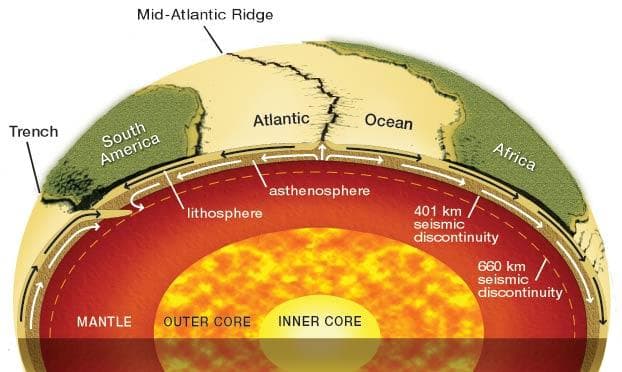
Plate tectonics, or the movement of pieces of Earth's crust, is thought to be caused by
Hot Spots
Earthquakes
convection currents in the Earth's mantle
volcanoes
13
Where does molten material rise from the mantle during sea-floor spreading?
faults
earthquakes
Deep Ocean Trenches
Mid ocean ridges
14
Any trace of an ancient organism that has been preserved in rock is called a
continent
fossil
landmass
landform
15
Where does subduction occur?
Mid Ocean RIdges
Mountains
Canyons
Deep Ocean Trenches
16
Mountain ranges form at which type of boundary?
convergent
transform
divergent
irregular
17
Why was Alfred Wegener's theory originally rejected by scientific peers?
His theory didn't make any sense.
He had no evidence.
He couldn't explain how the continents moved.
They already knew the continents could not move.
18
Which convergent boundary creates the highest mountain ranges?
continental - continental
ocean - ocean
ocean - continental
19
A convergent boundary is where the plates are
sliding past each other
moving apart
colliding together
20
A divergent boundary is where the plates are
colliding together
sliding past each other
moving apart
21
Magnetic stripes near mid-ocean ridges are evidence for sea-floor spreading because
magnetic fields differ on both sides of mid-ocean ridges
magnetic fields are same on both sides of mid-ocean ridges
shows the density of the oceanic crust
22
When divergent boundaries spread on land they form what?
mountains
mid-ocean ridges
rift valley
trenches
23
The continents are moving away from each other as magma rises from mid-ocean ridges. This is?
changing sea floor
underwater volcanos
sea floor rising
sea floor spreading
24
Which type of evidence is Wegner NOT use to support his theory of Continental Drift?
Landform Evidence
Water Evidence
Climate Evidence
Fossil Evidence
25
The theory that pieces of Earth’s lithosphere are in a slow constant motion is
deep-ocean trench
sea-floor spreading
plate tectonics
subduction