stud
bud
Sign up
Log in
Home
Library
Explore
SAT
More
Earth Science: Unit 3 Rocks and Processes Flashcards | StudBud
Explore
/
Earth Science: Unit 3 Rocks and Processes
Earth Science: Unit 3 Rocks and Processes
50 terms
·
StudBud Administration
·
8,349 plays
Imported from external platform
Flashcards
50 cards
F
Practice quiz
P
Host live
L
Questions
50
Answers
1
The energy source that drives the processes that form igneous and metamorphic rocks is found
in moving water
in the sun
from the wind
in the Earth's interior
2
When large masses of magma solidify far below the Earth's surface, they form igneous rocks ___.
that have a glassy texture
that have a clastic texture
that have a course-grained texture
that have a fine-grained texture
3
In a well-developed soil profile, which horizon is the uppermost layer?
the C horizon
the A horizon
the B horizon
the parent horizon
4
Which of the following processes involves the constant freezing and thawing of water?
exfoliation
spheroidal weathering
unloading
frost wedging
5
What type of sedimentary rock is formed from weathered particles of rocks and minerals?
intrusive sedimentary rock
chemical sedimentary rock
organic sedimentary rock
clastic sedimentary rock
6
Soil Conservation Methods doe NOT include:
Strip cropping
Fracking
Contour plowing
Hill terracing
7
The action of abrasion can best be described as _____.
coarse sand particles rolling along the desert surface
sand blown high into the air to cut /carve rock formations
windblown sand cutting and polishing exposed rock surfaces
the wind creating desert pavement
8
The rate of soil erosion depends on _____.
all of the above
slope steepness
climate
the type of vegetation
9
What type of rocks are formed by weather processes?
metamorphic rocks
sedimentary rocks
igneous rocks
No, rocks are formed by the sun.
10
When water freezes, its volume _____.
decreases slightly
stays the same
decreased greatly
increases
11
Sedimentary rocks with ripple marks suggest that the rocks formed _____.
when ancient animals walked over them
along a beach or stream bed
when mud dried and shrank
fro the shell fragments of ancient sea-dwelling animals
12
When a block of material moves downslope, the type of mass movement is called _______.
a slump
a rockslide
creep
a rockfall
13
A soil that is characteristic of the humid eastern US is _____.
humus
pedocal
laterite
pedalfer
14
A foliated metamorphic rock forms when crystals ____.
become less compact
combine but do NOT form visible bands
combine and form visible bands
align themselves parallel to the forces acting on them
15
Why can two igneous rocks have the same minerals but different names?
Thorax may be found in different areas.
The rocks may have different colors.
The rocks may have different textures.
The rocks may be of different sizes.
16
The primary agent of contact metamorphism is _____.
extreme pressure
weathering
flowing water
heat from magma
17
The process that occurs when physical forces break rock into smaller pieces is called ____
differential weathering
mechanical weathering
chemical weathering
erosion
18
Which of the following is NOT true about mass movements?
Gravity is the driving force behind all mass movement.
Mass movements always lead to landslides.
Some mass movements are too slow to be seen.
Mass movements are always downslope.
19
A mass movement that has a sudden movement of loose material along a flat, inclined surface
is called a flow
is called a rockfall
is called a slump
is called a landslide
20
Which of the following is the result of chemical weathering?
a rock that has been changed into 1 or more new compounds
a rock that has been broken into tiny pieces
a rock that has been split in two
a rock that has lost its outer layers
21
During what season would you expect mass movements to be a greater threat?
a wet spring with little vegetation
a dry autumn after the leave have turned
a dry summer
a wet spring with lots of vegetation
22
Which of the following is true about rocks?
Most rocks are a mixture of minerals.
Rocks are composed of only one mineral.
Rocks do not contain any non-mineral matter.
Coal is not considered a true rock.
23
A term that describes how icebergs are formed when large pieces of ice break off from a glacier
are called calving
are called plucking
are called wastage
are called accumulation
24
The process responsible for moving material downslope under the influence of gravity is called
mass movement
erosion
weathering
soil formation
25
What would cause the inscription on a marble gravestone to become harder and harder to read?
frost wedging
exfoliation
oxidation
acid rain
26
Lava that cools instantaneously and has crystals that do not have time to arrange themselves
have porphyritic texture
have course-grained texture
have glassy texture
have fine-grained texture
27
Which of the following is NOT associated with mechanical weathering?
frost wedging
oxidation
unloading
biological activity
28
How are soil horizons ordered from the top of the profile to the bottom?
B,A,C
C,B,A
A,C,B
A,B,C
29
A soil's texture is determined by ____.
particle size
type of humus
water content
mineral composition
30
A relatively rapid form of mass movement that is common in dry mountainous regions is ____.
creep
an earthflow
a slump
a mudflow
31
Whenever the characteristics and chemical composition of weathered materials have been altered,
they have undergone mechanical weathering
they have undergone frost wedging
they have undergone chemical weathering
they undergone mass movement
32
Which of the following is NOT a major component of soil?
humus
air
earthworms
mineral matter
33
One way to stabilize the mountains of Western NC would be to _____.
use cloud seeding
build retaining walls
use deforestation
use hydraulics
34
Which of the following is NOT a factor that affects the rate of weathering in rocks?
climate
biological evolution
amount of exposed surface area
rock characteristics
35
Chemical weathering would be _____.
equally effective in any climate
most effective in a cold, dry climate
most effective in a warm, humid climate
most effective in a warm, dry climate
36
Material deposited directly by a glacier is called _______.
till
a kettle
stratified drift
rock flour
37
A rock that forms when magma hardens beneath the Earth's surface is called an ____.
intrusive igneous rock
extrusive igneous rock
intrusive metamorphic rock
extrusive sedimentary rock
38
What kind of material is found in the C horizon of a soil profile?
bedrock
hardpan
mineral and organic matter
clay particles
39
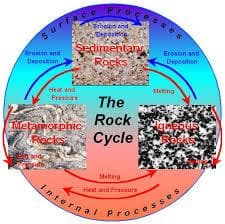
The 3 groups of rocks are classified by ______.
how they formed
chemical composition
color
grain size
40
What is the main type of weathering in deserts?
chemical weathering
weathering by organic acids
physical weathering
weathering by water
41
Why can the removal of vegetation trigger mass movements?
The plant roots bind the soil and regolith together.
The plant roots lubricate the loose sediment.
The shaking triggers mass movements.
The soil loses nutrients and begins to crumble.
42
Which of the following is a use for fossils found in sedimentary rocks?
matching rocks of the same age found in different places
interpreting past environments
all of the above
indicating when the rock formed
43
Which of the following is NOT one of the 3 types of rocks?
magma
sedimentary
igneous
metamorphic
44
As the rate of cooling for igneous rocks increases, the size of the crystals that form ______.
increases
decreases
cannot be determined
is not affected
45
Deflation affected the Dust Bowl in the 1930's by _____.
building up sand dunes
lowering the land
creating rock pinnacles
depositing coarse sand and gravel
46
What is the slowest type of mass movement?
creep
a slump
a rockfall
an earthflow
47
The B horizon is also called the _____.
subsoil
partially altered parent material
topsoil
unaltered parent material
48
The atmospheric gas that forms a mild acid when mixed with rainwater is _____.
carbon dioxide
aluminum
oxygen
sulfur
49
Where do glaciers form?
only in high mountains
only at the poles
only in oceans
in areas where more snow falls than melts
50
The main source of organic matter in soil is ____.
water
plants
fungi
bacteria