stud
bud
Sign up
Log in
Home
Library
Explore
SAT
More
Glencoe Red Science Chapter 10 Forces Shaping Earth Flashcards | StudBud
Explore
/
Glencoe Red Science Chapter 10 Forces Shaping Earth
Glencoe Red Science Chapter 10 Forces Shaping Earth
23 terms
·
StudBud Administration
·
177 plays
Glencoe Red Science, Middle School. Chapter 10. Forces Shaping Earth
Flashcards
23 cards
F
Practice quiz
P
Host live
L
Questions
23
Answers
1
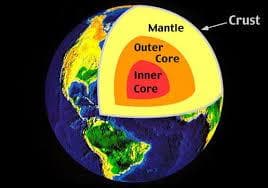
True or False: The largest part of Earth's interior is the mantle.
False
True
2
The slab-pull theory says the plates move away from the mid-ocean ridges and become
less dense
cooler
unevenly heated
3
type of plate collision in which plates have similar densities, so they buckle and fold
continental-continental collisions
separating plates
continental-oceanic collisions
oceanic-oceanic collisions
4
The ridge-push theory says that plate movement occurs at
where the ocean meets the continents
mid-ocean ridges
where continents touch each other
5
Type of plate collision that involves subduction and deep ocean trenches
oceanic-oceanic collisions
continental-oceanic collisions
continental-continental collisions
folded
6
Lithosphere is the scientific name for
crust
outer core
upper mantle
lower mantle
7
One plate sinking underneath another plate is called subduction.
True
False
8
A mid-ocean ride froms when plate separate.
False
True
9
When one plate sinks underneath another plate, this is called...
subduction
slab-pull
ridge-push
convection
10
Earthquakes occur at this kind of plate boundary
volcanic
separating plates
sliding plates
colliding plates
11
Starting from the CENTER of Earth, what is the correct order of the Earth's layers?
outer core, inner core, upper mantle, mantle, crust
Inner core, outer core, mantle, upper mantle, crust
crust, upper mantle, mantle, outer core, inner core
inner core, outer core, upper mantle, mantle, crust
12
A result of moving plates is that continents remain in the same location over time.
True
False
13
Asthenosphere is the scientific name for
mantle
upper mantle
outer core
crust
14
Mt. St. Helens and Mt. Popocateptl are examples of which type of mountains?
folded
upwarped
fault-block
volcanic
15
Older mountains such as the Appalachian Mountains are lower and more rounded because of
earthquakes
lightning
deposition
erosion
16
mountains formed by the folding of rock layers and caused by compressive forces
folded
upwarped
fault-block
volcanic
17
As depth increases to the center of the Earth, temperature decreases.
True
False
18
theory says uneven heating, different densities & cycling of materials cause plate movement
subduction
volcanic
collisions
convection
19
Plates move apart, causing a mid-ocean ridge
separating plates
colliding plates
subduction
sliding plates
20
The convection theory says that plate movement is caused by
uneven heating and differences in density
plates moving away from the mid-ocean ridges
21
Which of the following is NOT one of the three theories of plate movement?
convection
subduction
slab-pull
ridge-push
22
mountains made of huge, tilted blocks of rock separated from surrounding rock by faults
fault-block mountains
folded mountains
upwarped mountains
volcanic mountains
23
type of plate collisions in which oceanic plates slide under continental plates
continental-continental collisions
subduction
continental-oceanic collisions
oceanic-oceanic collisions