stud
bud
Sign up
Log in
Home
Library
Explore
SAT
More
European History 1400-1648 Flashcards | StudBud
Explore
/
European History 1400-1648
European History 1400-1648
50 terms
·
StudBud Administration
·
1,671 plays
AP European History review game
Flashcards
50 cards
F
Practice quiz
P
Host live
L
Questions
50
Answers
1
The Hundred Years’ War was fought between ________.
Germany and England
France and Russia
England and the Netherlands
France and England
2
Which of the following expresses a viewpoint held by Machiavelli?
Ancient Roman patriotism and self-sacrifice were ineffective
Ancient Romans did a poor job of defending their homeland
Republican ideals were outdated
Italian unity and independence were justified by any means
3
What English humanist wrote a famous book called
Utopia
?
Thomas Hobbes
Thomas More
Thomas Cromwell
Francis Bacon
4
What event was held in the attempt to unite the Swiss and German Protestants?
the Diet of Worms
the Diet of Augsburg
the Marburg Colloquy
the Peace of Augsburg
5
In what city did Calvin make his name?
Bern
Wittenberg
Zurich
Geneva
6
Hostilities between Spain and England reached a climax in 1588 when ________.
Henry III was assassinated
the Spanish Armada was sent to invade England
Henry IV was assassinated
the Edict of Nantes was signed
7
The first humanists were __________ .
farmers and blacksmiths
historians and musicians
orators and poets
politicians and their secretaries
8
The Roman Catholic Church recognized the need for reform and met from 1545–1563 at the
Marburg Colloquy
Diet of Worms
Council of Trent
Congress of Vienna
9
Luther’s response to the German Peasants’ Revolt proved that his reforms were ________.
more radical than most contemporaries thought
limited to Germany
religious, not social
aimed at all facets of German culture and society
10
Anabaptists are the sixteenth-century ancestors of which of the following modern groups?
Mormons
Lutherans
Baptists
Mennonites
11
Calvin’s work
Institutes of the Christian Religion
is considered ________.
a heretical work even by Protestant standards
a summary of the beliefs of Anabaptism
the definitive theological statement of Protestant faith
a rejection of the Catholic theology
12
The Reformation broke out first in the cities of________.
England and Germany
England and Switzerland
Germany and France
Switzerland and Germany
13
The great artists of the High Renaissance were________.
Vincent van Gogh, Donatello, and Giotto
Leonardo da Vinci, Raphael, and Michelangelo
Titian, Donatello, and Giotto
Titian, Vincent van Gogh, and Masaccio
14
The French monarchy was hostile towards Protestants until ________.
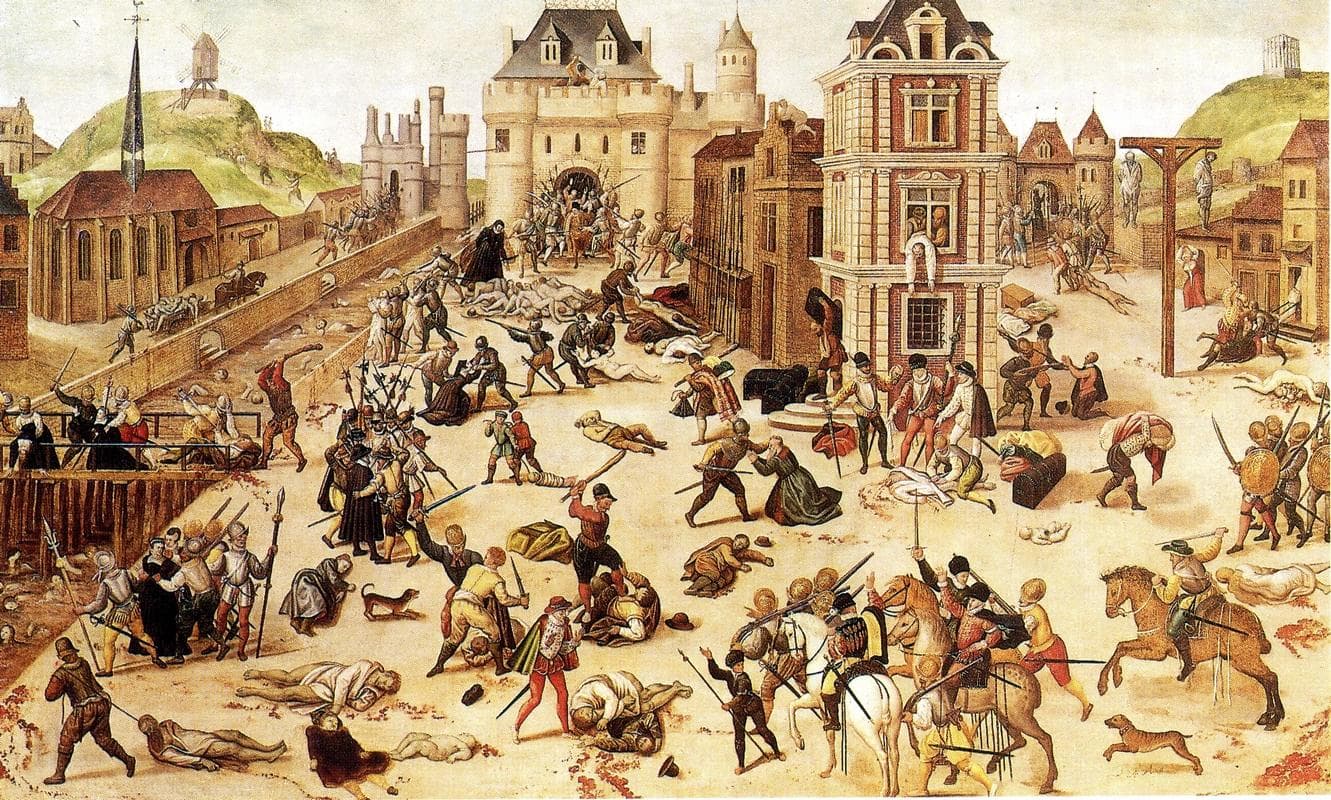
the Peace of Saint-Germain-en-Laye
the Saint Bartholomew’s Day Massacre
Henry of Navarre came to power
Elizabeth I provided financial and military support
15
The Reformation in Zurich was led by ________.
Ulrich Zwingli
Blaise Pascal
John Calvin
Henry of Navarre
16
The Act of Succession ________.
made James VI of Scotland Henry VIII’s heir
gave Parliament the right to choose the next monarch
made the first-born child of a king heir regardless of sex
made Anne Boleyn’s children legitimate heirs to the throne
17
Henry IV converted to Catholicism, motivated by________.
faith
fear of Catholic power
expediency
a promise he made to the Pope
18
The Hundred Years’ War took place primarily in _______.
Italy
England
Germany
France
19
What is William of Orange known for?
he suppressed the Protestant revolt with the Duke of Alba
He was the captain of the Spanish Armada.
He led the Turks against Spain
He led the movement for Dutch independence from Spain.
20
Who was known as the "father of humanism?"
Francesco Petrarch
Dante Alighieri
Leonardo da Vinci
Giovanni Boccaccio
21
Which of the following comprised Florence’s
popolo grosso
in the Renaissance?
the old merchant class
the lower urban classes
capitalists and bankers
guild masters
22
What finally resolved the Great Schism?
The Council of Constance
the resignation of Clement VII
The Marburg Colloquy
the abdication of Urban VI
23
The most important problem in the marriage between Henry VIII and Catherine of Aragon was that
Henry VIII needed a male heir
the couple lived in different countries
the couple had different religious views
Catherine had been raised in Spain
24
How did predestination factor into Calvin’s theology?
Predestination was important but not central to his theology
Predestination played a small part in Calvin’s theology
Predestination played no part in Calvin’s theology
Predestination was central to Calvin’s theology
25
Luther’s ninety-five theses ________.
sparked the Reformation in Germany
expressed his belief that salvation could be bought and sold
had little real impact
earned him a position teaching at Wittenburg University
26
Which of these provoked the Hundred Years’ War?
a French claim to the English throne
English possession of French land
disputes over Flanders
an English claim to the French throne
27
The phrase “Babylonian Captivity” refers to the________.
the Church in Bohemia after religious reforms
the Church in France during the 100 Years' War
period of papal residence in Avignon
persecution of the Lollards
28
The Black Death refers to ________.
a virulent plague that struck fourteenth-century Europe
the famine that occurred from 1315 to 1317
the collapse of the European economy in the 14th century
a disease transmitted through African slaves
29
The work of John Wycliffe most resembled that of_______.
John Calvin
Jan Huss
Thomas Aquinas
Joan of Arc
30
Which of the following was a result of the Columbian Exchange on Native Americans?
spread of a virulent form of syphilis
introduction of corn
introduction of a new species of fish
spread of measles and smallpox
31
Which of the following cities played a key role in the trade between Europe and the Near East?
Venice
Genoa
Bologna
Rome
32
What advantage did an indulgence grant the buyer?
the freedom from the church holiday obligations
remission of sins
the granting of an ecclesiastical post
release from time in purgatory
33
Medieval art tended to be abstract and formulaic,whereas Renaissance art showed ________.
sacred images painted on wood
scenes of domestic life
the natural world and human emotions
religious figures without faces
34
The Treaty of Westphalia finally granted Calvinists _________.
the authority to gather in public
legal recognition
the permission to worship within the borders of cities
the power to fortify their towns
35
Whose most famous painting is the
Mona Lisa
?
Raphael
Donatello
Michelangelo
Leonardo da Vinci
36
Who sponsored Genoese adventurer Christopher Columbus?
William III and Mary II
King Henry VIII
Catherine of Aragon
Isabella and Ferdinand of Spain
37
How was the Peace of Augsburg like the Treaty of Westphalia?
Both restricted the rights of Protestants throughout Europe.
Both denied the authority of the Holy Roman Emperor.
Both established that rulers determined official religions
Both established the right of Protestants to fortify towns.
38
What did Mary I of England, Philip II of Spain,and Oliver Cromwell all have in common?
They restricted religious worship in their countries
They refused to compromise on religion.
They were all considered politiques.
They were all Protestants.
39
________ was by far the most effective and outspoken critic of the Spanish conquerors.
Francisco Pizarro
Hernán Cortés
Bartolomé de Las Casas
Michel de Montaigne
40
By 1600, the population of the Holy Roman Empire was about ________.
70 percent Catholic
equally divided between Catholics and Protestants
40 percent Protestant
30 percent Catholic
41
Which religious movement was most successful attacking the late medieval church in England?
Franciscans
Waldensians
Lollards
Hussites
42
The term “Machiavellian” has become synonymous with ________.
slow decision-making
ruthless political expediency
tools made by machinists
welfare policies
43
The papal bull
Unam Sanctam
declared that ________.
the Holy Roman emperor could establish national churches
only strong monarchies could fulfill the Christian gospel
temporal authority was subject to spiritual authority
a new crusade was necessary to unify Europe
44
The ruler of Spain for most of the later 1500s was _________.
Philip II
Charles V
Carlos I
Ferdinand I
45
John XXII tried to return the papacy from ________ to Italy.
Mainz
Avignon
Milan
Paris
46
Following the weakening of Spain this nation dominated Europe in the early seventeenth century
France
Italy
England
Germany
47
Humanism prepared the way for Protestant reforms in which of the following countries?
England, France, and Germany
France, England, and Denmark
England, France, and Spain
Germany, the Netherlands, and Spain
48
The Peace of Augsburg recognized that __________ .
Protestants everywhere must restore Catholic beliefs
the ruler of a state determined the religion in his country
Calvinists were to be tolerated throughout Europe
religion of a state was determined by theHoly Roman Emperor
49
Cosimo de’ Medici brought stability to which city after his rise to power in 1434?
Rome
MIlan
Venice
Florence
50
The Council of Trent’s most important reforms concerned ________.
discipline within the church
religious tolerance
transubstantiation
the power structure of the church