stud
bud
Sign up
Log in
Home
Library
Explore
SAT
More
Chemistry Review Flashcards | StudBud
Explore
/
Chemistry Review
Chemistry Review
25 terms
·
StudBud Administration
·
1,764 plays
SNC1D Chemistry Unit Review
Flashcards
25 cards
F
Practice quiz
P
Host live
L
Questions
25
Answers
1
What is the number of valence electrons for nitrogen?
7
2
5
6
2
Dissolving sugar and water is an example of a:
Physical change
Chemical change
3
Rusting of iron is an example of:
Chemical change
Physical change
4
The amount of space between particles of a gas are:
Move freely at high speeds
All of the above
Tightly compact
Close together
5
Ductility is the ability to stretch and malleability is the ability of a metal to deform
False
True
6
The atomic number of an element is 11 and it has an atomic mass of 23. The element has:
12 electrons, 12 protons, 11 neutrons
11 electrons, 10 protons, 12 neutrons
11 electrons, 11 protons, 12 neutrons
11 electrons, 11 protons, 11 neutrons
7
Which group on the periodic table are the most reactive?
Alkali metals
Noble gases
Halogens
All of the above
8
The formula, C
3
H
2
, is:
Molecular
Ionic
9
Which of the following is
not
an example of a heterogeneous mixture?
Chocolate chip cookies
Blood
Pizza
Rocks
10
Which of the following is true about the periodic table?
All the non-metals are on the left and in the middle
The non-metals are on the right
The metals are on the right and in the middle
The metals are on the right
11
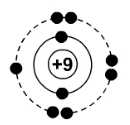
The following is a bohr-rutherford diagram of oxygen
False
True
12
True or False: a pure substance contains only one type of particle
True
False
13
In evaporation, is heat added or removed to change the state of water?
Added
Removed
14
Oxygen, chloride, and fluorine usually form:
Positive ions
Negative ions
15
The following are examples of pure substances
except for
:
Sand
Water
Sugar
Salt
16
Lithium, Sodium, and Potassium are examples of:
Alkali metals
Halogens
Noble gases
Non-metals
17
The following diagram is a liquid at which temperature:
Cool temperature
When heated
Room temperature
18
Which of the following is NOT a clue to a chemical change?
There is a change in colour
There is a change in temperature
Heat and/or light is given off
The substance melted
19
Why is the metal lithium so reactive?
It is highly flammable
It has a single valence electron
It is an alkali metal
All of the above
20
Dinitrogen Trioxide is:
Molecular
Ionic
21
The following structural diagram's formula is:
CH4
CH2
C2H2
H2O
22
Matter is:
All the above
Classified into mixtures
Classified into pure substances
Anything that has mass and takes up space
23
An ionic compound forms when a metal gains an electron and a non-metal loses an electron
True
False
24
The following is the Lewis-dot diagram for chlorine
True
False
25
Which of the following about particle theory is false:
The particles are never moving
All matter is made up of particles
All particles have space between them
Pure substance particles are identical