stud
bud
Sign up
Log in
Home
Library
Explore
SAT
More
Bio A Test #3 - Botany Review Flashcards | StudBud
Explore
/
Bio A Test #3 - Botany Review
Bio A Test #3 - Botany Review
31 terms
·
StudBud Administration
·
719 plays
Review of structure and function of plant cells, tissues and organs basics for grade 11 biology.
Flashcards
31 cards
F
Practice quiz
P
Host live
L
Questions
31
Answers
1
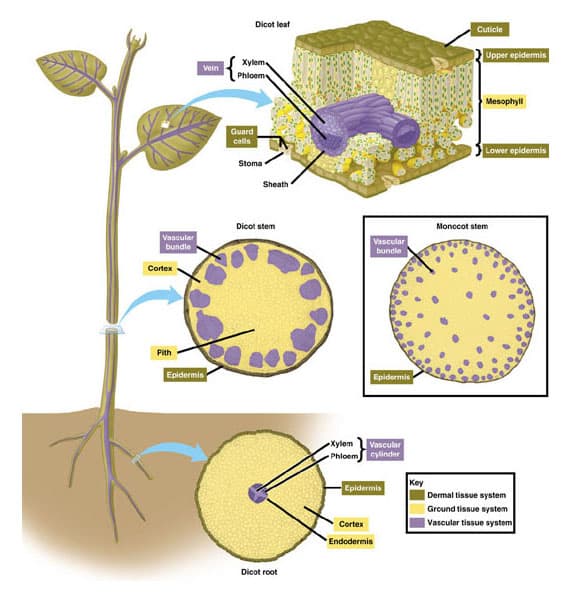
This plant tissue is often used for storage and support of materials
ground
vascular
meristematic
dermal
2
Which letter is the spongy mesophyll where photosynthesis occurs?
B
D
A
E
3
Plants lose most of their water through a process called what?
cohension
evaporation
photosynthesis
transpiration
4
Letter E will open and close for what purpose?
gas exchange
collect water
collect light
release sugars to air
5
The correct levels of organization in living things is...
organs -> systems -> tissues -> cells
systems -> organs -> cells -> tissues
tissues -> organs -> cells -> systems
cells -> tissues -> organs -> systems
6
What are the three major organs of plants?
Roots, stems and leaves
leaves, shoots and stems
roots, stems and flowers
shoots, stems and flowers
7
What is the hormone that will inhibit or slow growth in plants?
ethelyne
abscisic acid
auxins
gibberellins
8
Letter E in the diagram is the...
vascular tissue
mesophyll
cuticle
stomata
9
What is the hormone that allows plants to grow toward light (stimulates growth)?
ethelyne
abscisic acid
auxins
gibberellins
10
The diagram shows a stem of a ____ plant.
dicot
monocot
11
The two major plant systems are...
roots and leaves
roots and shoots
shoots and leaves
roots and stems
12
This plant tissue is composed primarily of cells that transport materials
ground
dermal
meristematic
vascular
13
What are substances that are produced in one part of a plant that affects another part?
enzymes
oxygen
herbicides
hormones
14
This plant tissue often forms the waxy cuticle for protection
ground
vascular
meristematic
dermal
15
This type of vascular tissue carries water and dissolved minerals
meristematic
guard cells
phloem
xylem
16
The way a plant responds to an environmental stimuli is called...
herbicide
hormone
auxin
tropism
17
This plant tissue is where new cells are made for plant growth
vascular
ground
dermal
meristematic
18
When a plant moves sugars from the leaves to the roots, the source is the ___ and the sink is the ___.
stems, roots
roots, leaves
leaves, roots
leaves, stem
19
Stomata are what?
tough, waxy outer layer of leaves
part of flower that makes pollen
channels in vascular tissue used for transport
openings in leaves for gas exchange
20
Which tropism is shown here?
thigmotropism
phototropism
gravitropism
chronotropism
21
Primary growth a plant take place where?
dermal tissue
ground tissue
apical meristem
lateral meristem
22
Which tropism is shown here?
phototropism
chronotropism
gravitropism
thigmotropism
23
What is the main function of the leaf?
sugar transport & starch storage
water & nutrient absorption
reproduction & support
photosynthesis & gas exchange
24
secondary growth a plant take place where?
lateral meristem
ground tissue
dermal tissue
apical meristem
25
Which type of roots store carbohydrates (nutrients) and absorb water?
Tap & Fibrous
Fibrous & Modified
Tap & Modified
Tap, Fibrous & Modified
26
Which tropism is shown here?
phototropism
thigmotropism
chronotropism
gravitropism
27
What letter in the diagram forms a waxy coating that helps reduce the loss of...
B
A
E
D
28
Letter A in the diagram is the...
mesophyll
cuticle
vascular tissue
stomata
29
What is the hormone promotes fruit to ripen?
abscisic acid
auxins
ethelyne
gibberellins
30
Minerals from soil move into roots by what process?
root pressure
diffusion
transpiration
active transport
31
This type of vascular tissue carries organic nutrients from where they are made to where needed
guard cells
xylem
meristematic
phloem