stud
bud
Sign up
Log in
Home
Library
Explore
SAT
More
Unit 5: South, East, and Southeast Asia Flashcards | StudBud
Explore
/
Unit 5: South, East, and Southeast Asia
Unit 5: South, East, and Southeast Asia
32 terms
·
StudBud Administration
·
1,026 plays
AP Art History Review, Mrs. Wain
Flashcards
32 cards
F
Practice quiz
P
Host live
L
Questions
32
Answers
1
_____, which demonstrates how Buddhism spread from India to China, was patronized by
Angkor Thom; Jayavarman VII in the Angkor Dynasty
Longmen Caves; Empress Wu in the Tang Dynasty
Borobudur; Sailendra Dynasty
Angkor Wat; Suyavarman II in the Angkor Dynasty
2
The Forbidden City built that housed Ming and Qing dynasty rulers was intended to
serve as the emperor's mausoleum
reflect the emperor's role as the Son of Heaven
be a public forum for government and civic business
serve as a military training ground
3
The Taj Mahal was built by _______ from the __________ empire, an Islamic empire in India.
Qin Shihuang; Qin
Shah Jahan; Mughal
Ashoka; Maurya
Empress Wu; Tang
4
This landscape can be attributed to
Fan Kuan
Katsushika Hokusai
Imperial Bureau of Painting
Lin Chunhua
5
This Japanese artist was influenced by Dutch prints, and Prussian blue.
Ogata Korin
Katsushika Hokusai
Bichitr
Fan Kuan
6
This funeral banner was made for ___________________ during the ______ dynasty.
Devi, Han
Lakshmi, Qin
Lady Dai, Qin
Lady Dai, Han
7
When visiting this Hindu temple, you would do all of the following EXCEPT:
cleanse yourself before entering and take off your shoes
circumambulate clockwise to the garba griha
bring offerings for the murti or to place on other statues
place your offerings directly on the statue of the deity
8
The Bamiyan Buddhas experienced a type of _________ at the hands of the Taliban.
repurposing
regeneration
renaissance
iconoclasm
9
Travelers Among Mountains and Streams and Portrait of Sin Sunkju were both made using
oil paint on canvas
ink or color on silk
ink on rice paper
woodblock printing
10
The mudra seen in this sculpture signifies
meditation
do not fear
Buddha touching the earth, and earth acting as his witness
preaching the law
11
The Taj Mahal, its gardens, and its water features
were faced in white stucco
were designed for Shaj Jahan's tomb
was made in the Chola dynasty
were meant to resemble an Islamic paradise
12
The Hindu deity, or _________, resides in the inner sanctum, or ___________, in the Lakshmana Temple.
relic; harmika
shikhara; mandapa
murti; garba griha
yashti; torana
13
Using ink on silk, Fan Kuan represents
a faithful depiction of specific location
Neo-Confucian ideals of li and qi
a specific moment in time
Chinese mountain mythology
14
The following are true of the temples at Angkor EXCEPT:
they were constructed by two different Khmer kings
both were Buddhist temples
Angkor Wat was built to resemble Mt. Meru
they were built in Cambodia
15
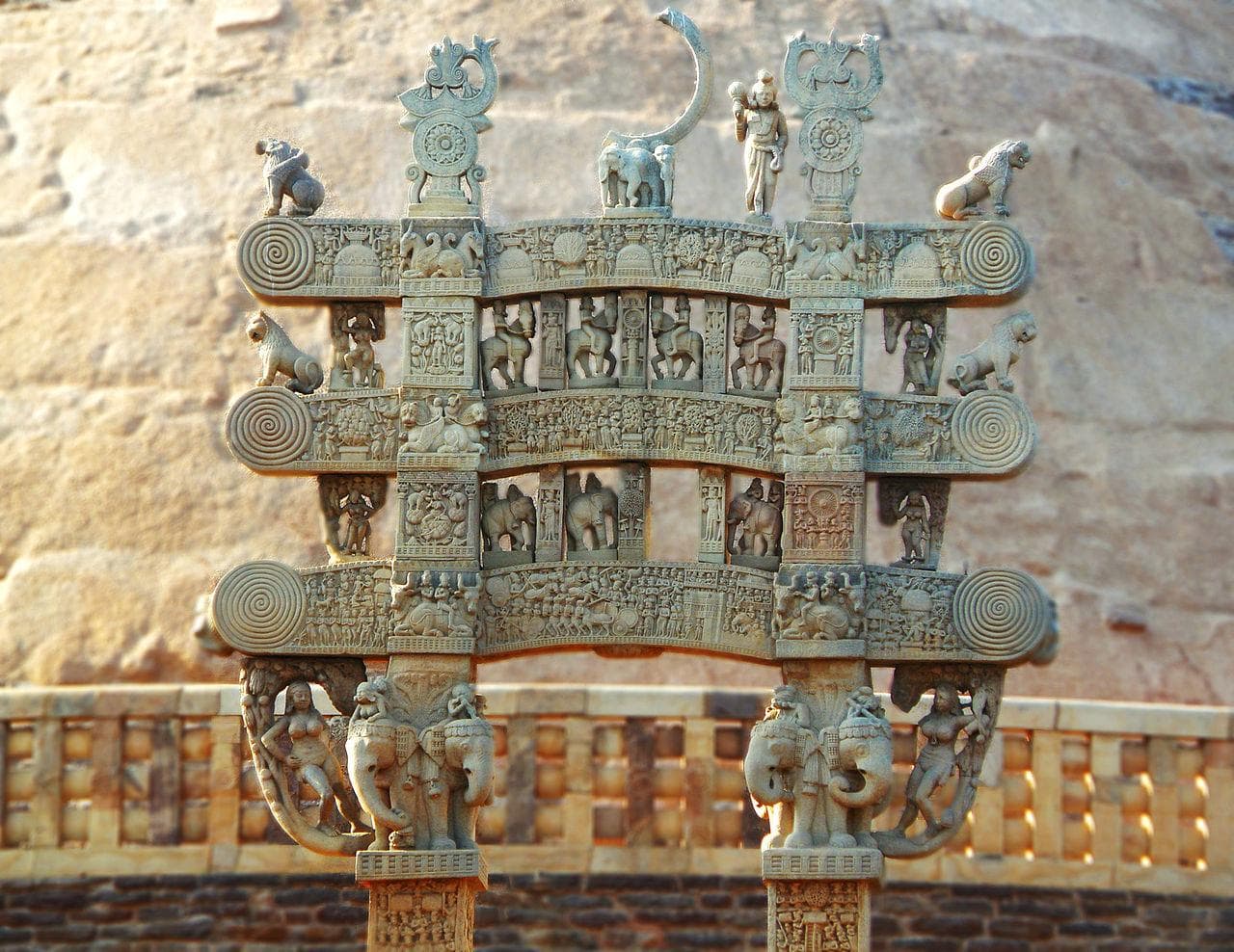
At Sanchi, the ___ is the home of the gods, the ___ is the axis mundi, and the ___ are gates.
torana; chatras; yasti
harmika; yasti; torana
stupa; yasti; chatras
yasti; chatras; stupa
16
The Great Stupa at Sanchi is an early Buddhist monument, and was constructed
300 BCE-100 CE
400-800 CE
1500 BCE
1200-1500 CE
17
The following are true of the terracotta warriors EXCEPT, they were:
1/3 life size
made with molds so parts could be mixed to make unique forms
made of terracotta clay and then painted
made in 221-209 BCE to be buried next to Qin Shihuang's tomb
18
This work depicts ___ and was made during the _____.
Chairman Mao; Cultural Revolution
Emperor Jahangir; Mughal Dynasty
Emperor Qin Shihuang; Sino-Japanese War
Sin Sukju; Joseon Dynasty
19
The shape of the jade cong is meant to symbolize
immortality
heaven and hell
life and death
an axis mundi
20
The David Vases were intended to function as
an offering in a Daoist temple
an urn
a mixing bowl for water and wine
a historical narrative
21
The entrance of the city of Angkor Thom featured
Shiva as Nataraja
Three-headed Vishnu
faces of Jayavarman VII as a Buddha or Bodhisattva
Suyavarman II as Vishnu
22
Ukiyo-e is the classification used for artwork made in Japan during this time period
17th-19th c. CE
15th-16th c. CE
8th-10th c. CE
20th c. CE
23
These amorous sculptures adorn the Lakshmana Temple from this dynasty in 10th c. India.
Chandella
Mughal
Qin
Han
24
This painting exemplifies the ______________ School of Painting from 18th c. Japan.
Ukiyo-e
Rinpa
Ecole des Beaux Arts
Literati
25
The following are true of the Rock (dry) gardens at Ryoan-ji EXCEPT:
they are associated with Zen Buddhism
they are tools to help meditate
they contain tea houses
they resemble large-scale natural formations found in nature
26
The following are true of Todai-Ji EXCEPT:
it is a Buddhist temple constructed of unpainted wood
Emperor Shomu wished to unite Japan with Buddhism
it is in its original form
it contains the largest metal cast Vairocana Buddha
27
In the Fengxian Cave of the Longmen caves, these figures are on either side of the Buddha
Nio Guardians and Ikenga
Boddhisatva and Vajropani
Boddhisatva and Shiva
Vajropani and Yakshi
28
Chinese blue and white porcelain was a result of
the development of Prussian blue in Europe
Iranian merchants introducing cobalt blue to China
Iranian potters exporting Chinese-inspired wares
the influence of Dutch delftware
29
These are the advantages of printmaking, as seen in The Great Wave & Chairman Mao are, EXCEPT
prints can only be made by the artist
appeal to a wide audience
easy to mass produce
they are cheap
30
Western influences appear in Jahangir Preferring a Sufi Shaikh to kings in
the hourglass throne
the medium, painted miniature
the garments of Bichitr
the appearance of putti and King James I
31
The following are true of the original Bamiyan Buddhas in Afghanistan EXCEPT:
they were constructed by Chinese emperors
they were meant to be circumambulated
they were painted and featured Greek style Gandharan drapery
they were visited by Buddhist travelers on the Silk Road
32
The following are true of Jowo Rinpoche EXCEPT:
it came to China from Tibet
it is a pilgrimage destination for Tibetan Buddhists
it sits in the Jokhang temple in Lhasa, Tibet
the statue is powerful because of its likeness to the Buddha