stud
bud
Sign up
Log in
Home
Library
Explore
SAT
More
Chapter 6 Test Review 2018 Flashcards | StudBud
Explore
/
Chapter 6 Test Review 2018
Chapter 6 Test Review 2018
42 terms
·
StudBud Administration
·
494 plays
Periodic table vocabulary and periodic trends
Flashcards
42 cards
F
Practice quiz
P
Host live
L
Questions
42
Answers
1
The element with the largest atomic radius is ______.
Uuo
H
Fr
He
2
Who arranged the elements according to atomic mass and their properties?
Mendeleev
Dalton
Rutherford
Moseley
3
Where are the halogens?
Group 18 / 8A
Group 2 / 2A
Group 17 / 7A
Group 1 / 1A
4
A period in the periodic table corresponds to _______.
principal energy level
atomic mass
energy sublevel
atomic number
5
Where are the noble gases?
Group 18 / 8A
Group 1 / 1A
Group 17 / 7A
Group 2 / 2A
6
Electronegativity __________ down a group.
decreases
increases
remains constant
7
The energy required to remove an electron from an atom is ___________.
atomic radius
shielding effect
electronegativity
ionization energy
8
Metals __________ electrons to become stable.
gain
stay the same
lose
9
Atomic radii __________ down a group.
remain constant
decrease
increase
10
Ionization energy __________ down a group.
decreases
remains constant
increases
11
Why are some straws missing from the electronegativity models?
Mrs. Millard is careless.
Students are careless.
Those elements do not need to attract electrons.
They were misplaced when the models were moved.
12
Where are the alkali metals?
Group 18 / 8A
Group 1 / 1A
Group 2 / 2A
Group 17 / 7A
13
The most reactive nonmetal is _____.
Uus
F
He
H
14
The element with the smallest atomic radius is _____.
Uuo
Fr
He
H
15
Atomic radii increase down a group because there are more __________.
valence electrons
sublevels
orbitals
principal energy levels
16
Which is larger- O atom or O ion?
O ion
O atom
17
Electronegativity __________ across a period.
increases
decreases
remains constant
18
The most reactive metal on the periodic table is _____.
F
Fr
H
He
19
In what period is Cu (atomic no. 29)?
4
8B
3
11
20
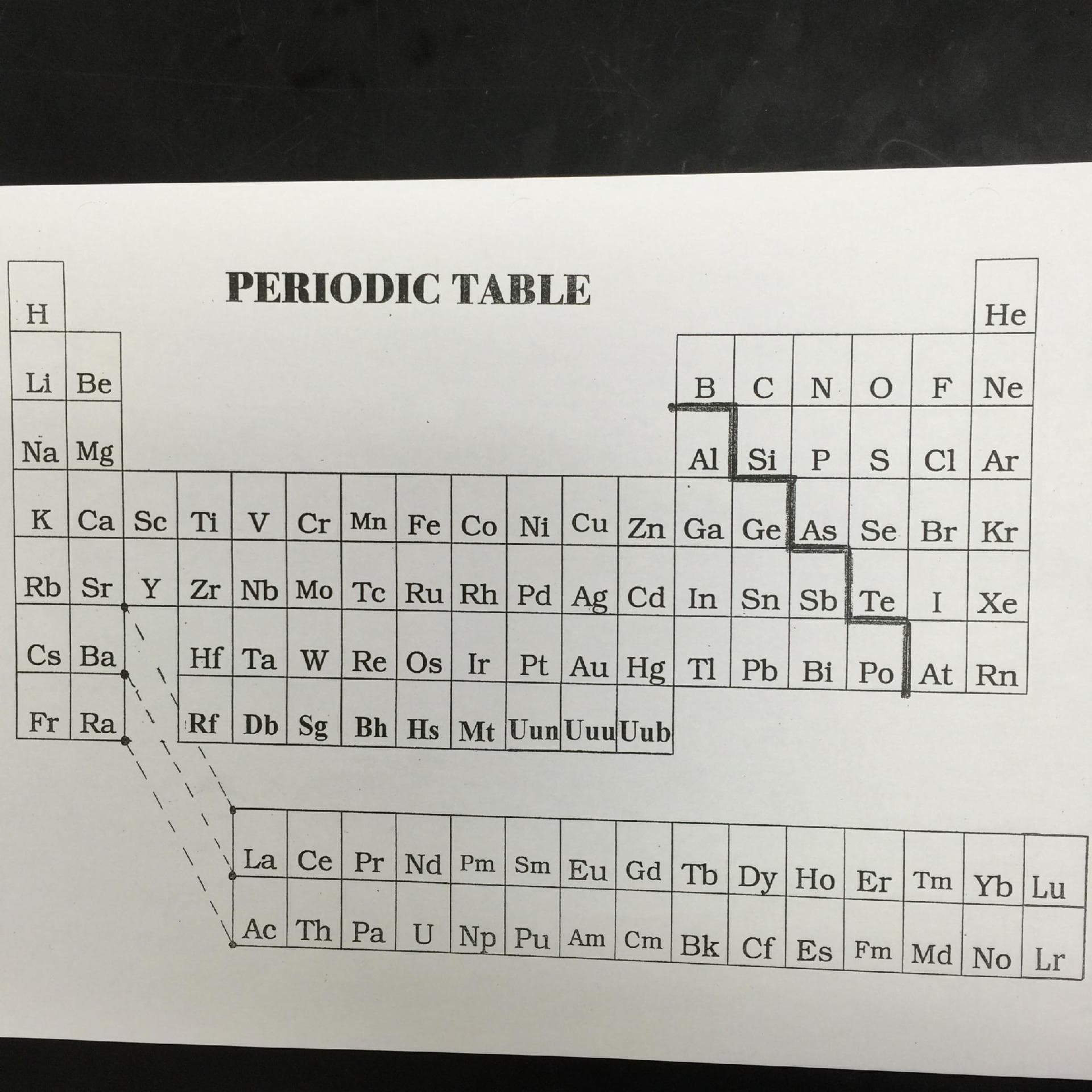
Mystery element Q is shiny, conductive, and brittle. Where is it located?
right of the stairstep
two rows below the table
left of the stairstep
touching the stairstep
21
Which is larger- K atom or K ion?
K atom
K ion
22
The element with the greatest ionization energy is _____.
Uuo
He
Fr
H
23
Where are the alkaline earth metals?
Group 1 / 1A
Group 2 / 2A
Group 17 / 7A
Group 18 / 8A
24
Where are the transition elements located on the periodic table?
p block
f block
s block
d block
25
Mystery element A is brittle, nonconductive, and not lustrous. Where is located?
two rows below the table
right of the stairstep
left of the stairstep
touching the stairstep
26
Solubility _______________ down the alkaline earth metals.
increases
decreases
remains constant
27
Which one is NOT a metalloid?
B
Ge
Si
Al
28
Which particle determines the physical and chemical properties of an element?
electron
proton
neutron
muons
29
Ionization energy __________ across a period.
remains constant
decreases
increases
30
The s and p blocks are known as the __________.
lanthanides and actinides
representative elements
inner transition elements
transition elements
31
Positive ions are made by atoms __________ electrons to become stable.
gaining
losing
32
Negative ions are made by atoms __________ electrons to become stable.
losing
gaining
33
Nonmetals __________ electrons to become stable.
lose
stay the same
gain
34
What are vertical columns on the periodic table called?
rows
periods
groups
transitions
35
The element with the greatest electronegativity is _____.
Fr
F
Uus
He
36
What is the principal energy level of Ne (atomic no. 10)?
2
18
8A
0
37
Elements in the same column of the periodic table have the same number of _______.
principal energy levels
protons
valence electrons
similar atomic mass
38
The tendency to attract electrons when in combination with another element is ___________.
shielding effect
ionization energy
atomic radius
electronegativity
39
Why are noble gases chemically unreactive?
Their s and p orbitals are full.
They are gases.
They are nonmetals.
Their d orbitals are full.
40
What are rows on the Periodic Table called?
groups
families
periods
columns
41
Atomic radii __________ across a period.
increase
remain constant
decrease
42
A precipitate looks _________ in a reaction plate.
clear
cloudy