stud
bud
Sign up
Log in
Home
Library
Explore
SAT
More
History of Ancient India Flashcards | StudBud
Explore
/
History of Ancient India
History of Ancient India
60 terms
·
StudBud Administration
·
566 plays
Imported from external platform
Flashcards
60 cards
F
Practice quiz
P
Host live
L
Questions
60
Answers
1
What happened after the Guptas took control of India?
Indians could not practice Buddhism.
Hinduism became less popular.
Hinduism became more popular.
Indians could not practice Jainism.
2
According to Buddha, how could people reach nirvana?
by accepting their place in the world
by practicing nonviolence
by reincarnation into a higher form
by following the eight-fold path
3
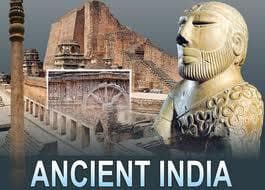
conclusion that can be drawn from a Harappan statue of a man with elaborate clothes and jewelry
Harappans placed a high value on appearance.
Harappan society had an upper class.
Harappans had kings and a strong central government.
Harappans were skilled engineers.
4
Which Indian piece of literature contains the passages called the Bhagavad Gita?
the Panchatantra
the Siddheswara
the Ramayana
the Mahabharata
5
Which of the following phrases best describe the Mauryan Empire?
a loose government, large army, no taxes
a complex central government, small army, low taxes
a complex central government, large army, heavy taxes
a localized government, no army, heavy taxes
6
going without food
relaxing
nirvana
meditating
fasting
7
Which of the following events happened last?
Siddhartha Gautama meditated underneath a tree.
Siddhartha Gautama became disenchanted with life.
Siddhartha Gautama wandered through forests for years.
Siddhartha Gautama gained insight into human suffering.
8
In Aryan society, which of the following was highest importance in regard to the caste system?
adhering to the strict rules of the caste system
interacting with people of different castes
helping people from lower castes to rise up
moving to a higher level of the caste system
9
The Vedas are collections of poems, hymns, myths, and rituals written by Aryan priests.
FALSE
TRUE
10
According to Buddha’s teachings, suffering comes from
the negative karma that we have built.
our desires for pleasure and material goods.
the fallen state of humanity.
acts of the gods.
11
Much of what we know about the Aryans comes from
the sutras.
Harappan writings.
archaeology.
the Vedas.
12
According to tradition, Siddhartha Gautama achieved enlightenment while
meditating under a tree.
giving his first sermon.
listening to Mahariva.
fasting at a pilgrimage site.
13
A basic concept in Jainism is
acceptance of one’s place in the world.
nonviolence
karma
meditation
14
According to Hinduism, people are reborn into new physical forms depending on a person's
moksha.
sutra.
karma.
dharma.
15
After years of division, India was reunited during the
Asoka period.
Gupta dynasty.
Aryan period.
Mauryan dynasty.
16
people who spread their religious beliefs
artisans
moks
priests
missionaries
17
The Buddha supported the caste system in order to win followers among the masses.
TRUE
FALSE
18
The ancient Indians can boast of few significant achievements.
TRUE
FALSE
19
After Asoka converted to Buddhism
planned to conquer neighboring kingdoms to spread Buddhism.
he retired to a monastery.
he promised to fight no more wars of conquest.
his empire began to fall apart.
20
the force created by a person's actions
religion
dharma
nirvana
karma
21
injecting a person with a small dose of a virus
healing
innoculation
poison
sickening
22
According to Hindu tradition, after a person dies,
they are reborn into a new physical form.
their soul becomes part of the universe.
they achieve moksha or salvation.
they must approach the throne of Vishnu.
23
With which of the following statements would the Buddha likely disagree?
Suffering and unhappiness are a part of human life.
Nirvana is achieved by overcoming ignorance and desire.
Suffering comes from not having what one wants.
Contentment springs from gaining what one wants.
24
The Harappa civilization thrived from
2300 BC to 1700 BC.
AD 320 to AD 480.
320 BC to 184 BC.
500 BC to 200 BC.
25
We know names of several Indian artists as well as the members of Gupta society who paid them
FALSE
TRUE
26
Siddhartha Gautama began his life as
the son of a priest.
a rich prince.
the son of a laborer.
an orphan in a monastery.
27
Hinduism taught that each person has a duty to
practice nonviolence
accept his or her place in the world.
spread the teachings of the Vedas.
meditate daily.
28
language of Ancient India
Quechua
Chinese
Spanish
Sanskrit
29
The numbers we used today were created by
Indian scholars.
the Harappans.
the Huns.
Aryan priests.
30
According to early Hindu teachings, women
could not attain salvation in their current lives.
were not permitted to study the Vedas.
should not be restricted.
were equal to men.
31
Harappans’ contact with other cultures was mostly in the form of
trade.
tourism.
religious missions.
diplomacy.
32
Paintings of the Buddha were forbidden in temples.
FALSE
TRUE
33
In what way was the caste system changeable?
A group of families could decide to form a new caste.
could change castes by marrying someone ofa different caste
Entire castes could become untouchables.
Entire castes could gain or lose favor in society
34
Which of the following describes how Hindu temples changed in the Gupta period?
The temples became more complex.
The temples became more basic and simplistic.
The temples were built without towers.
The temples no longer included carvings of gods.
35
Which of the following describes Theravada Buddhism?
Theravada Buddhists follow the Buddha's teachings exactly.
Theravada Buddhism is based on the teachings of Mahariva.
Theravada Buddhists have rejected the Buddha's teachings.
Theravada Buddhism is the largest branch of Buddhism today.
36
Which of the following best describes the relationship between the Vedic texts and the Vedas?
Vedic texts contained the same sacred hymns as the Vedas.
The Vedas described how Aryans should use the Vedic texts.
Vedic texts were a collection of thoughts about the Vedas.
The Vedas were based on the teachings in the Vedic texts.
37
Which people originally memorized their poems and hymns?
the Aryans
the Guptas
the Mauryans
the Harappans
38
the process of a soul being reborn in a new body
karma
reincarnation
nirvana
dharma
39
Indian astronomers were aware of
other solar systems.
inoculation techniques.
the distances between planets.
the fact that the sun is a star.
40
Aryan society was very similar to Harappan society.
FALSE
TRUE
41
Buddhist ideas were appealing to people in all levels of society.
TRUE
FALSE
42
a major river flowing through India
Huang He
Nile
Indus
Euphrates
43
What was the Gupta policy on religion?
they didn't care about it
they only allowed the practice of Hinduism
they supported no religions
Hinduism main religion,but supported other religions as well
44
The most powerful king of the Mauryan Empire was
Mahariva.
Asoka.
Kalidasa.
Candragupta Maurya.
45
The highest-ranking varna was
the Vaisyas.
the Brahmins.
the untouchables.
the Kshatriyas.
46
The caste system divided Indian society into groups based on birth, wealth, or occupation.
FALSE
TRUE
47
the science of working with metals
plumber
<span style="font-size: 11px;">steel worker</span>
metallurgy
ironology
48
Which of the following statements describes the Aryan system of government?
It was based on a strong central government.
It was led by scholars who could write.
Its leaders were often skilled warriors.
It did not allow local leaders.
49
Aryan rajas tended to fight amongst themselves often.
FALSE
TRUE
50
Which of the following is not included in the Vedic texts?
historical accounts of the Aryan migration
descriptions of how to perform sacrifices
reflections on the Vedas by religious people
hymns to gods
51
Siva the Destroyer and Vishnu the Preserver are examples of
characters in the Panchatantra.
Hindu gods.
Buddha’s early followers.
Gupta rulers.
52
What fact supports the idea that the Harappans were skilled engineers?
The Harappans’ two main cities were remarkably similar.
The Harappans had a writing system.
The Harappans used wheeled vehicles for transportation.
The Harappans built extensive sewer systems in their cities.
53
the division of Indian society into groups
caste system
division system
Group system
wrong system
54
The Gupta Empire was eventually defeated by the Huns from Central Asia.
TRUE
FALSE
55
a military leader who seized control of northern India
Asoka
Atahualpa
Candragupta Maurya
Cotes
56
Stupas are important to Buddhists because
they were blessed by the Buddha.
they have images of the Buddha carved on them.
they have edicts carved into them.
they hold sacred items from the life of the Buddha.
57
What is the largest religion in India today?
BuddhisM
traditional religions
Jainism
Hinduism
58
The Panchatantra is
a collection of long passages about Hindu beliefs.
the story of prince Rama’s battle with demons.
the story of 2 families’ struggle for control of a kingdom.
a collection of stories intended to teach lessons.
59
Both Harappa and Mohenjo Daro were located near the
city of Bodh Gaya.
Arabian Sea.
Thar Desert. b. Arabian Sea.
Indus River.
60
How did Siddhartha Gautama seek answers to his questions?
He spent several years wandering around India.
He had discussions with wise people.
All of the above
He spent much of his time meditating.