stud
bud
Sign up
Log in
Home
Library
Explore
SAT
More
Bio MCAS - Kingdoms Flashcards | StudBud
Explore
/
Bio MCAS - Kingdoms
Bio MCAS - Kingdoms
13 terms
·
StudBud Administration
·
13 plays
Modified past MCAS questions provide a review for students comparing the six kingdoms.
Flashcards
13 cards
F
Practice quiz
P
Host live
L
Questions
13
Answers
1
Which of the following organisms is eukaryotic, multicellular, and autotrophic?
amoeba
oak tree
mushroom
squid
2
The diverse organisms shown in the diagram below belong to the which Kingdom.
Protista
Plantae
Fungi
Animalia
3
Which kingdom? Eukaryotic, multicellular, has a cell wall, and contains chloroplasts.
Fungi
Animalia
Protista
Plantae
4
Which structure in a leaf cell is responsible for preventing it from bursting when in water?
nucleus
cell membrane
mitochondrion
cell wall
5
How can the organisms in the kingdom Fungi be distinguished from other eukaryotic organisms?
Fungi are unicellular.
Fungi obtain nutrients by absorption.
Fungi make food through photosynthesis.
Fungi reproduce sexually.
6
Which kingdom? Multicellular, cells have no cell wall, heterotrophic, and moves
Protista
Animalia
Fungi
Plantae
7
Which of the following is more likely to occur in a plant cell than in an animal cell?
B. formation of cellulose
A. synthesis of enzymes
C. breakdown of glucose
D. active transport of ions
8
Which of the following statements describes a way in which plant and animal cells are similar?
Both types of cells are autotrophic.
Both types of cells are prokaryotic.
Both types of cells have cell walls.
Both types of cells contain mitochondria.
9
To assign a new organism to a domain and kingdom, scientists must know the organism's
social behavior
cell structure
population size
reproductive rate
10
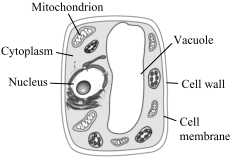
Which of the following provides evidence that this cell comes from a plant and not an animal?
a functional mitochondrion
a single nucleus
a large vacuole
a selectively permeable cell membrane
11
To which kingdom does an organism that is eukaryotic, unicellular, lacks a cell wall belong?
Plantae
Protista
Animalia
Fungi
12
Which of the following describes plant cells but not animal cells?
The ribosomes assist in protein synthesis.
The nucleus contains the chromosomes.
Mitochondria produce energy through respiration.
Plastids store starch made during photosynthesis.
13
In which of the following ways does a bacterial cell differ from an animal cell?
Bacterial cells have more mitochondria than animal cells.
Bacteria have RNA for its genetic material, animals don't
A bacterial cell is much larger than an animal cell.
A bacterial cell does not have membrane-bound organelles.