stud
bud
Sign up
Log in
Home
Library
Explore
SAT
More
Investigating the Ancient Past Revision Flashcards | StudBud
Explore
/
Investigating the Ancient Past Revision
Investigating the Ancient Past Revision
30 terms
·
StudBud Administration
·
148 plays
Investigating the past basics #year7history #investigatingtheancientpast #nswhistory
Flashcards
30 cards
F
Practice quiz
P
Host live
L
Questions
30
Answers
1
Which came first?
100 CE
1000 BCE
100 BCE
1000 CE
2
This wall artwork would be a
best source
primary source
biased
secondary source
3
The scientific study of material remains (as fossil relics, artefacts, and monuments) is done
by historians
by communists
by archeologists
by anthropoligists
4
BCE stands for
Before Common Era
Before Christ Ever
Before Christian Era
Before Common Evil
5
What are we in now?
BCE
22nd Century
CE
20th Century
6
The study of the nature and structure of language and how it has changed over time is done by
Archeologists
Linguists
Anthropologists
Cryptographer
7
The study of codes and writing systems is done by
archeologists
Cryptographer
anthropologists
historians
8
A person who investigates plant and animal fossils to study the biology of past life forms is a
Linguists
Archeologists
Palaeontologist
Cryptographer
9
Something that was created at the time of an era or event is known as a
secondary source.
thirdary source.
primary source.
oscar.
10
In which year did Christianity become the official religion of the Roman Empire?
390CE
392CE
392BCE
390BCE
11
Trade helped ancient civilizations by..
being able to steal from other groups
making them very rich
surplus of food/goods meant they could trade with other town
trading new materials and exchange of new ideas
12
Inclination or prejudice for or against one person or group is known as
bias
communism
disgust
exaggeration
13
Access to water helped ancient civilizations to survive by..
creating more jobs through a growing population
letting them build boats
providing fertile soil to grow crops and raise animals
causing floods and keeping enemy away
14
A text book that was written in 2007 about ancient Egypt would be a
most interesting.
secondary source.
primary source.
good text.
15
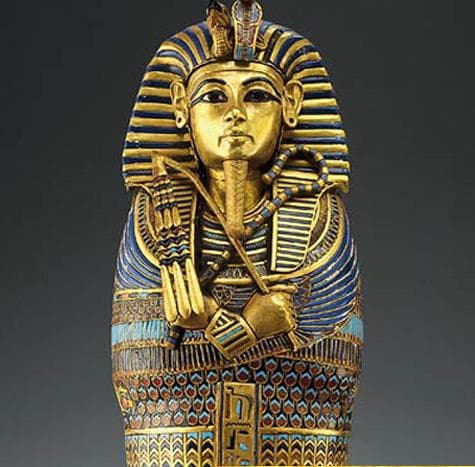
The images on the side of this wall art are called
olde writing
hieroglyphics
sphinx
sarcophagus
16
The ancient Egyptians existed in
10th Century
1200 CE
1000 BCE
500 CE
17
What is this known as and what type of source is it
hieroglyphics - primary source
hieroglyphics - secondary source
sarcophagus - secondary source
sarcophagus - primary source
18
The year 530 CE is in which century?
6th Century
5th Century
4th Century
50th Century
19
CE stands for
Current Era
Common Era
Current Ear
Common Ear
20
What can we learn from artwork?
What they worn and materials they used
Who they spent time with
Artistic styles
What sort of animals were around
21
What can we learn from modern day reconstructions?
What materials were available
How old the reconstruction is
How often people moved these structures
How big or small groups were by size of structure
22
If we went back 3000 years we would be in
-30th Century
BCE
CE
Medieval History
23
A secondary source usually uses
information gained from studies of that era
multiple primary and secondary sources
too much bias and useless information
pictures of dead bodies
24
The comparative study of human societies and cultures and their development is done by
historians
anthropologists
communists
archeologists
25
A person uses the sciences (Chemistry and biology) and scientific methods (DNA analysis) are
Historians
Cryptographer
Anthropologists
Scientific Experts
26
What can we learn from skeletons?
diet from teeth
Health of person from condition of skull and injuries
what animals they used in life
where they had traveled over their lives
27
Social hierarchy helped ancient civilizations by..
rich people taking all the money and food
making all the slaves do the work
specialisation of jobs of different levels of society
allowing wealthy nobles to become decision makers of society
28
Laws and regulations helped ancient civilizations by..
avoiding violence and creating a safer environment
creating harsh punishments so all criminals were killed
ensuring slaves did what they were told
providing a system for people to resolve grievances
29
A person who searches for and recovers remains from the past such as tombs and buildings are
Historians
Cryptographer
Anthropologists
Archeologists
30
An expert in or student of history, especially that of a particular period is known as a
Archeologist
Historian
Communist
Anthropologist