stud
bud
Sign up
Log in
Home
Library
Explore
SAT
More
AP Art History Renaissance Flashcards | StudBud
Explore
/
AP Art History Renaissance
AP Art History Renaissance
48 terms
·
StudBud Administration
·
25 plays
Imported from external platform
Flashcards
48 cards
F
Practice quiz
P
Host live
L
Questions
48
Answers
1
The Last Judgment scene in the Sistine Chapel is notable for its
departure in tone from the ceiling paintings
Use of trompe l’oeil frames to contain the human figures
restrained emotion and movement
failure to depict hell as a part of the final judgment of man
2
This work represents a fundamental change in that it:
humanizes the holy family
depicts Mary in equal importance to Christ
portrays Biblical figures in the clothes of the era
depicts a moment in the life of Christ
3
What is the name of this work?
the Delphic Sibyl
the Erythraean Sibyl
the Anointed Virgin
Eve before the Fall
4
Which of the following is NOT true of this work?
Exaggerated contrapposto is present
David is epicted as circumcised, in keeping with Old Testament accounts
Citizens of Florence would have identified with David as an underdog
the figure's small physique suggests God's intervention in his victory
5
Where can the following work be found?
Il Gesu
the palace of Versailles
Church of Santa Maria della Vittoria
the Sistine Chapel
6
A printmaking process in which lines are carved into a metal plate or wooden board, then filled with ink and printed
etching
engraving
contouring
chiarascuro
7
Who are the two men pictured in the center of the painting?
Pope Julius II & Pope Leo X
Plato & Aristotle
Moses & Abraham
Michelangelo & Raphael
8
This work was part of a series of 4 paintings depicting the seasons.
False
True
9
Who painted the ceiling of the Sistine Chapel?
Raphael
Michelangelo
Botticelli
Leonardo da Vinci
10
This work is widely considered to be a marriage portrait:
False
True
11
Who commissioned the painting of the Sistine Chapel?
Pope Leo X
Pope Innocent VIII
Pope Julius II
Pope Pius III
12
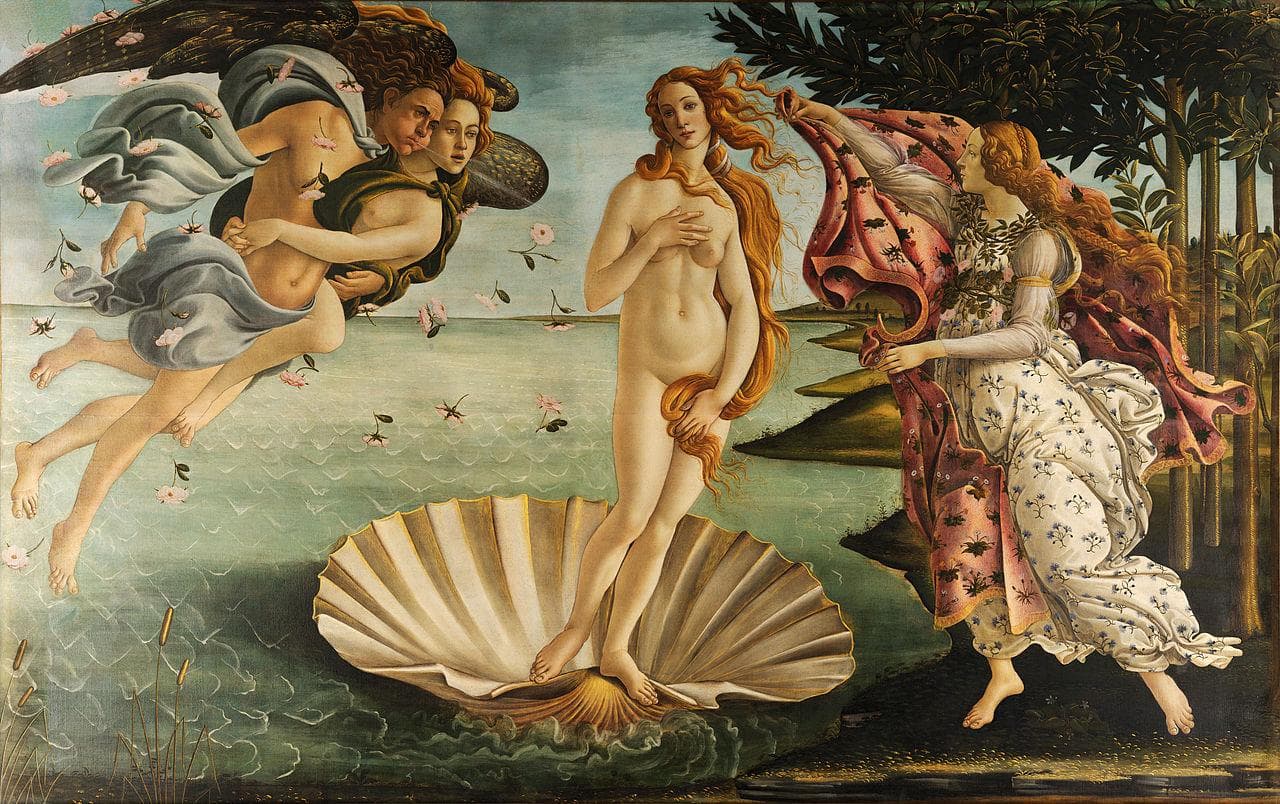
Who is the artist of the following work entitled "The Birth of Venus"?
Sandro Botticelli
Leonardo da Vinci
Raphael
Fra Filipo Lippi
13
The scene depicted in this work deals with
the crucifixion
the lamentation
the annunciation
the last judgment
14
The panel on the left (when facing the work) is an example of
Renaissance humanism
Classical influence
donor portraiture
linear perspective
15
Which of the following scenes is NOT a part of this work (remember there are many panels ;))
the annunciation
the last judgment
the crucifixion
the lamentation
16
To which artist would you attribute this work?
Titian
Raphael
Donatello
Fra Lippi
17
To which artist would you attribute this work?
Matthias Grunewald
Lucas Cranach the Elder
Albrecht Durer
Leonardo da Vinci
18
Which Italian city was the center of the early Italian Renaissance?
Rome
Milan
Venice
Florence
19
The animals in the work are thought to represent:
the four pillars of the church
the seven deadly sins
the four "humours" of the human body
Matthew, Mark, Luke, and John
20
What is the function of the Sistine Chapel?
a place for clergy to eat
a combination chapel and library
a chapter house for clergy meetings
a chapel for popes
21
A printmaking process that relies on acid to "bite" the engraved design into the printing surface
etching
engraving
chiarascuro
contouring
22
Which of the following was NOT a focus of Renaissance humanism?
physically and intellectually active life
civic and personal virtue
close adherence to Church tradition
personal effort and responsibility
23
Which of the following forms/techniques is NOT associated with this work?
gold-painted highlights
orthogonal/linear perspective
graceful lines
atmospheric perspective
24
The patron of this work was a member of the Medici family.
False
True
25
The following work is representative of which of the following artistic movements?
Northern Baroque
Northern Renaissance
Italian Renaissance
Venetian
26
The artist associated with this work is
Van Eyck
Durer
Bruegel
Grunewald
27
The artist who created this work is known primarily for their use of
line and color
fresco work
controversial subject matter
religious symbolism
28
What is the medium of the following work?
tempera and oil; fresco
oil on canvas
engraving
oil paint on wood
29
To which artist would you attribute this work?
Fra Filippo Lippi
Titian
Raphael
Donatello
30
What is the artistic technique demonstrated in this work?
contrapposto
chiaroscuro
cloisonne
collage
31
What was the purpose of this work?
to promote Protestant theology
to focus on God's judgment
to attract people back to the Catholic church
to focus on God's grace
32
This work was found in:
a church, at the altar
a medical monastery
a chapel
a private home
33
Which ancient Roman structure does this building mimic?
the Arch of Constantine
the Colosseum
the Pantheon
the Forum of Trajan
34
Who is the architect of this building?
Bramante
Palladio
Alberti
Brunelleschi
35
Who is the architect of this building?
Brunelleschi
Palladio
Bramante
Alberti
36
Which of the following is NOT a feature in the Sistine Chapel?
Christ in the Garden of Gethsemane
Ancient sibyls
Noah drunk and disgraced
The Creation
37
Which artist is associated with this (colorized version depicted) work?
Van Eyck
Durer
Grunewald
Cranach the Elder
38
All of the figures in "School of Athens" lived during the same historical era
False
True
39
Who is the artist of the following work?
van Eyck
Raphael
Michelangelo
Donatello
40
Who is the artist of the following work?
Fra Filipo Lippi
Donatello
Michelangelo
Botticelli
41
Which of the following is NOT a feature of this work?
dramatic composition
orthogonal/linear perspective
symmetry
atmospheric perspective
42
What is the name of the following work?
Palazzo Rucellai
Cornaro Chapel
Sistine Chapel
Pazzi Chapel
43
The painting technique used to create this work is known as
dry brushing
impasto
glazing
underpainting
44
A worldview centered on the nature & importance of humanity that emerged from the study of Classical antiquity
humanism
Stoicism
hedonism
idealism
45
Which artist is associated with this work?
Durer
Grunewald
Van Eyck
Bruegels
46
The artist associated with this work is
Van Eyck
Grunewald
Durer
Cranach the Elder
47
The artist associated with this work is
Durer
Bruegels
Grunewald
Campin
48
This work was found in:
a church, at the altar
a monastery
a hospital chapel
a private home