stud
bud
Sign up
Log in
Home
Library
Explore
SAT
More
Ch. 6 Holt Earth Science: Rock Flashcards | StudBud
Explore
/
Ch. 6 Holt Earth Science: Rock
Ch. 6 Holt Earth Science: Rock
41 terms
·
StudBud Administration
·
597 plays
Freshmen Science quiz questions on the rock cycle & 3 types of rock
Flashcards
41 cards
F
Practice quiz
P
Host live
L
Questions
41
Answers
1
The process by which different minerals in rock melt at different times
partialmelting
compositionalmelting
Bowen’sreaction series
2
Rock that forms when existing rock is changed
Sedimentary
Igneous
Metamorphic
3
Sedimentary rock formed from pieces of other rock
organic
chemical
clastic
4
Rock that has a large proportion of silica and feldspar
intermediate
felsic
mafic
5
Which of the following factors does
NOT
affect how rock melts?
fluids in rock
pressure
light
temperature
6
Sedimentary rock formed when a solution precipitates
Chemical
Clastic
Organic
7
A metamorphic rock texture that has mineral grains arranged in bands, or stripes
nonfoliated
foliated
felsic
mafic
8
Magma or igneous rock that is rich in feldspar and silica
glassy
felsic
porphyritic
mafic
9
What happens when heat from nearby magma causes changes in the surrounding rock?
Regional Metamorphism
Foliated Metamorphism
ContactMetamorphism
FractionalMetamorphism
10
What causes rock to change in regional metamorphism?
it doesn't change
fromcontact with magma
contact with nonfoliated rock
fromchanges in temperature and pressure
11
Which of the following is
NOT
an example of an intrusion?
volcano
laccolith
batholith
sill
12
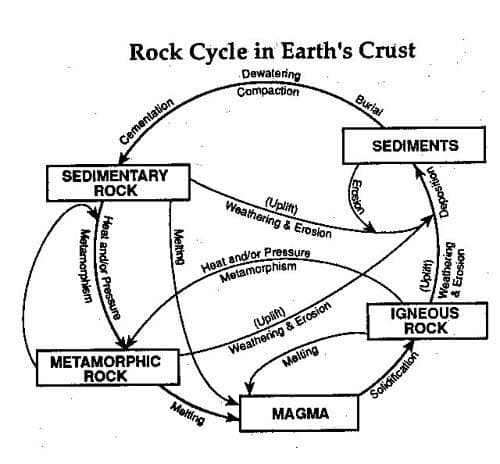
Series of changes - describes how geological forces make rock change from one type to another
Mohshardness scale
therock cycle
Bowen’sreaction series
13
In regional metamorphism, rock changes because of _.
Changesin temperature and pressure over a large area
Activityon one continent
Limitedoccurrences in a single region
Changes that happenonly above or only below Earth’s surface
14
Rock with fine grain texture
cooledslowly
cooled underground
cooledvery quickly
15
Factors that determine whether rock melts: temperature, fluid in the rock, and _
pressure
airdensity
surroundingrock
thecrystal content
16
The tendency for currents of air or water to separate sediments according to size
sorting
classifying
arranging
organizing
17
A common zone of weakness in rocks:
ajoint
achemical bond
weathering
a crack
18
What type of sedimentary rock is formed from minerals that were once dissolved in water?
inorganic
chemical
organic
clastic
19
Which of the following does
NOT
change the form of existing rock?
brightlight
tremendouspressure
extremeheat
achemical process
20
The process by which different minerals melt at different temperatures
dissolving
decaying
partialmelting
tempering
21
Sedimentary rock formed from rock fragments
clastic
extrusive
organic
chemical
22
Shows the order of mineral crystallization according to chemical composition and melting point
Bowen's reaction series
Mohshardness scale
The rock cycle
23
The process in which sediments are glued together by minerals deposited by water
compaction
foliation
cementation
metamorphism
24
What type of rock texture is shown when minerals separate into dark and lightbands?
felsic
nonfoliated
foliated
mafic
25
Sedimentary rock formed from the remains of plants or animals
organic
clastic
chemical
26
Rock that forms when deposits of dirt and rock are cemented and harden
Metamorphic
Igneous
Sedimentary
27
A rock that contains a fossil is most likely _
a sedimentaryrock
a metamorphic rock
a clastic rock
an igneousrock
28
Rock that forms from lava at Earth’s surface
Clastic
Extrusive
Chemical
Intrusive
29
The series of processes in which rock forms and changes by geological processes
rock cycle
fractionalcrystallization
bowen's series
30
The process in which sediment is squeezed and pore space becomes smaller
compaction
metamorphism
cementation
31
Which of the following is
NOT
a feature of sedimentary rock?
marble
stratification
cross-beds
fossils
32
Which of the following is
NOT
one of the three major types of rocks?
sedimentary: formed from compressedsediment deposits
metamorphic: formed when existing rock isaltered
igneous:formed from cooled magma
obsidian: formed from rock with smallcrystals; like glass
33
Large, well-developed crystal are a sign that _.
Waterdeposited minerals in the rock cavities
Thelava cooled rapidly
Themagma contained a lot of dissolved gasses
Thelava cooled slowly
34
Most metamorphic rock forms as a result of _
magmaflows
foliation
. regionalmetamorphism
chemical contact
35
Rock that forms when magma or melted rock cools and hardens
sedimentary
igneous
metamorphic
36
The melting of rock does
NOT
depend on which of the following?
temperature
]pressure
thepresence of fluid
thecolor of the rock
37
Rock changes into other rock b/c of changes intemperature, pressure +/or chemical processes
metamorphism
eruption
meltingand cooling
sedimentation
38
Rock formed from magma cooling beneath Earth’s surface
Extrusive
Intrusive
Metamorphic
39
When a rock changes because of changes in temperature and pressure, or other chemical processes
cementation
compaction
rock cycle
metamorphism
40
Which of the following does
NOT
affect the stability of rocks?
zones of weakness
chemicaland physical weathering
theintensity of color
chemicalbonds between atoms in the minerals
41
Rock that does not contain silica, but has a large proportion of magnesium and iron
mafic
felsic
intermediate