stud
bud
Sign up
Log in
Home
Library
Explore
SAT
More
Chapter 4 Test Review: The American Revolution Flashcards | StudBud
Explore
/
Chapter 4 Test Review: The American Revolution
Chapter 4 Test Review: The American Revolution
39 terms
·
StudBud Administration
·
1,336 plays
Imported from external platform
Flashcards
39 cards
F
Practice quiz
P
Host live
L
Questions
39
Answers
1
This Enlightenment concept taught that all men are endowed with _______ at birth.
knowledge
inate intelligence
intrinsic values
natural (unalienable) rights
2
_____________ was a leader of Continental forces in the West and defeated the British at Fort Sackville.
Charles Cornwallis
Bernardo de Galvez
George Rogers Clarke
John Paul Jones
3
What is another name for the Loyalists?
Tories
Redcoats
Continentals
Whigs
4
Colonists who choose to fight for independence from Great Britain were known as....
minutemen
Patriots
Redcoats
Loyalists
5
Among the list of 10 resolutions included in the Declaration of Rights, one was...
assure colonists that "Britian sought a peaceful resolution."
convince the colonists that they were "not ready to challenge Britain."
ensure the colonists' rights to "life, liberty, and property."
remind the colonists that they were British citizens "entitled to rights."
6
The Declaration of Independence addressed the rights of African Americans and Native Americans, but not women.
False
True
7
Delegates in the 1st Continental Congress were far from unified, but open to compromise.
True
False
8
The main issue debated during the 2nd Continental Congress was where to attack the British.
True
False
9
Bonus Question: Who is credited with creating the 1st American flag in 1777?
Bob Ross
Ross Koenig
Betsy Ross
10
Benjamin Franklin's son was an avowed __________.
Loyalist
Patriot
Anarchist
Whig
11
This sailor captured many British supply ships and won a naval victory against the
Serapis.
John Paul Jones
George Rogers Clark
Marquis de Lafayette
Bernardo de Galvez
12
This battle took place on the day after Christmas, December 26th, 1776.
Battle of Trenton
Battle of Princeton
Battle of Freeman's Farm
Battle of Guilford Courthouse
13
What militia did the 2nd Continental Congress authorize as the Continental Army?
Massachusetts
Rhode Island
Virginia
New York
14
Which British commander made a critical mistake in the southern theatre of the war in 1781?
Gen. Cornwallis
Gen. Clinton
Gen. Howe
Gen. Burgoyne
15
Why was the Battle of Trenton so important to Washington?
He wanted to continue his defensive approach to the war.
His mercenary forces were threatening to rebel.
He feared his political career would be over if he lost.
He feared his army would dissolve if they lost.
16
Why was the Battle of Saratoga a turning point of the war?
The Patriots got a Prussian to train the army.
THe Patriots saved army from losing men.
The Patriots gained military support from France and Spain.
The Patriots realized they did not need help from France.
17
What announcement prompted thousands of slaves to sign on with the British Army?
Emancipation Proclamation
Dunmore Proclamation
Olive Branch Petition
Proclamation of Freedom
18
What British General had to surrender his army at the conclusion of the Battle of Saratoga?
General William Howe
General John Burgoyne
General Thomas Gage
General Charles Cornwallis
19
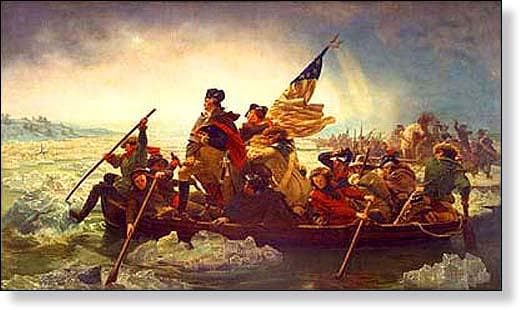
What German painter created the painting
Washington Crossing the Delaware
?
Hans Schultz
Emmanuel Leutze
Richard Wagner
Frederick von Frankenstein
20
What prompted the 1st Continental Congress to meet in Philadelphia in October of 1774?
The Tea Act
The Townshend Acts.
The Intolerable Acts
The Stamp Act.
21
Common Sense
argued that laws should be made by _____________.
church leaders
citizens
kings and queens
white male landowners
22
The idea that colonists could break free from Britain was based on this Enlightenment concept.
supremacy of the monarchy
equality of men
natural rights
social contract
23
Where were the first shots
(The shot heard 'round the world)
of the American Revolution fired?
Boston
Breed's Hill
Concord
Lexington
24
Common Sense,
by Thomas Paine, led many colonists to do what?
Agree with British laws.
Side with the Loyalists
Challenge Britain's rule over the colonies
Better understand the supremacy of King George III
25
Known as the "Swamp Fox", he used guerrilla tactics to harass British troops in the South.
Marquis de Lafayette
Francis Marion
Nathaniel Greene
Comte de Rochambeau
26
________ drilled American soldiers during the winter of 1777-1778 at Valley Forge.
Comte de Rochambeau
Francis Marion
Nathaniel Greene
Baron Friedrich von Steuben
27
Thomas Jefferson believed in the social contract and natural rights, key Enlightenment ideals
True
False
28
Patrick Henry said " I am not a Virginian, I am an American!" Why did he say this?
To ask colonists to abolish slavery.
To urge colonists to join forces with the Patriots.
To express his anger at his colony of Virginia.
To defend his resistance to violence.
29
_______ commanded 4,000 French troops at the Battle of Yorktown.
Charles de Gaulle
Napoleon Bonaparte
Marquis de Lafayette
Comte de Rochambeau
30
What was
NOT
included in the terms of the Treaty of Paris?
Britain formally recognized the United States
Americans allowed to settle west of original 13 colonies.
Land west of 13 colonies given to France.
Set America's borders
31
The 1st Continental Congress drafted the ____, a list of 10 resolutions to be sent to the king.
Bill of Rights
Declaration of Independence
Declaration of Rights
Olive Branch Petition
32
What was the main issue(s) debated during the 2nd Continental Congress?
How to convert more colonists to the Patriot cause.
How to plan a surprise attack against G. Britain.
whether to seek peace or plan for war with Great Britain.
Which foreign allies would be most beneficial.
33
The rejection of the Olive Branch Petition led to the meeting of the 1st Continental Congress.
False
True
34
The 2nd Continental Congress signed the _________, as a final effort to make peace with G.B.
Olive Branch Petition
Magna Carta
Declaration of Rights
Declaration of Independence
35
British soldiers went searching for hidden weapons in _______, a small town outside of Boston.
Charlestown
Worchester
Lexington
Concord
36
Which Founding Father acted as America's chief negotiator trying to secure French aid?
Thomas Jefferson
John Adams
Ben Franklin
Marquis de Lafayette
37
The _________ was the 1st MAJOR battle of the Revolutionary war and was a tragic victory for the British.
The Battle(s) of Lexington and Concord
The Battle of Bunker (Breed's) Hill
The New York Campaign
The Battle of Trenton.
38
How was Washington able to defeat Cornwallis at Yorktown?
Loyalist did not aid Cornwallis as much as he had hoped.
Washington's troops captured Cornwallis' top commanders.
His troops surrounded the British, cutting off escape routes
Washington led a surprise attack on Cornwallis.
39
The __________ officially ended the war between Britain and America in 1783.
Treaty of Rome
Treaty of Madrid
Treaty of Paris
Treaty of Berlin