stud
bud
Sign up
Log in
Home
Library
Explore
SAT
More
Animal and Plant Terms Flashcards | StudBud
Explore
/
Animal and Plant Terms
Animal and Plant Terms
40 terms
·
StudBud Administration
·
1,534 plays
year 13 NCEA Biology terms animals and plants
Flashcards
40 cards
F
Practice quiz
P
Host live
L
Questions
40
Answers
1
Rhythm with a period of about one tidal cycle when under constant environmental conditions.
circa-annual
circa-tidal
circa-lunar
circadian
2
An innate internal mechanism controlling the physiological activities of an organism (timing)
environmental cue
Zeitgeber
CNS
biological clock
3
Relationship between two organisms where both benefit (e.g. cleaner fish and sharks).
mutualism
ritualistic
agnostic
commensalism
4
Process by which an internal clock becomes reset by rhythmic environmental conditions.
biological clock
entrainment
period of rhythm
free-running
5
Plant that flowers when day length exceeds a certain minimum value.
day neutral
phytochrome
short day
long day
6
Plant that flowers when day length is less than a certain minimum value.
short day plant
long day plant
7
A graph showing the activity of an organism over a period of time.
Actogram
Learned
Behaviour
Activity graph
8
Mass movement of a species, usually a two way journey at regular intervals, long distances.
Homing
Migration
holidays
Flying
9
Ability of an organism to find its way home over unfamiliar territory.
homing
migration
navigation
10
what type of tropism is shown in this picture?
negative geotropism
positive phototropism
negative phototropism
positive geotropism
11
Night length below which long-day plants flower and above which short-day plants flower.
phytochrome
photoperiod
critical day length
critical ight length
12
Prefix for animal or plant responses to light, chemicals, gravity and water current IN ORDER
photo- chemo- geo- rheo-
chemo- gravi- photo- geo
chemo-, photo- current- rheo- gravi
13
You can put a positive or negative prefix for a kinesis responseshown by an animal
True
False
14
Behaviour which is not learned over time - behaviour the organism is born with (coded in genes)
Coded
Learned
Innate
15
Rhythm with a period of about a lunar month when under constant environmental conditions.
circa-tidal
circa-lunar
circadian
circa-annual
16
Active at night, active at day, active at dawn and dusk (in order)
nocturnal, crepuscular, diurnal
crepuscular, diurnal, nocturnal
nocturnal, dirurnal, crepuscular
dirurnal, nocturnal, crepuscular
17
A series of signals exchanged between males and females, often ending in mating.
dancing
communication
competition
courtship
18
Rhythm with an internal origin, independent of changes in the external environment.
external
endogenous
internal
exogenous
19
When several unpalatable organisms resemble each other to gain benefit - eg
camoflague mimicry
mullerian mimicry
batesian mimicry
20
Reversable movements in plant parts-response to the presence or absence of external stimuli
nastic response
taxis
tropism
kinesis
21
Prefix for behaviour responses to touch
rheo-
thigmo-
touchy-
tactile-
22
Rhythm with a period of about a day when under constant environmental conditions.
circadian
circa-lunar
circa-annual
circa-tidal
23
Using the sun to find the direction of migration. Must compensate for the suns daily movement.
sun compass
star compass
magnetic compass
24
When a harmless organism mimics a dangerous organism to gain benefit
batesian mimicry
camoflague mimicry
mullerian mimicry
25
You can put a positive or negative prefix for a nastic response in plants
False
True
26
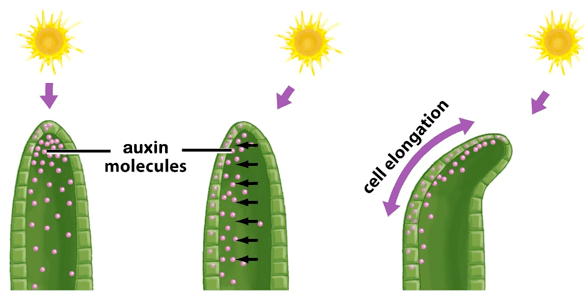
Growth hormone which plays an essential part in tropisms – causes cell elongation.
Phytochrome
Gibberelins
Auxin
Cytokinin
27
Movement of an animal - direction of the movement depends on the direction of the stimulus.
taxis
nastic response
kinesis
tropism
28
Peaks of an endogenous rhythm are advanced or retarded in response to a changed exogenous cue.
exogenous
phase shift
entrainment
zeitgeber
29
Situation when demand for a resource (e.g food) exceeds supply, both parties -vely affected.
pedation
competition
stimulus
cooperation
30
Aggressive behaviour between members of the same species. Can result in death or grevous injury
Agnostic
Aggressive
31
Members of a group arranged in positions of dominance or subordinance to reduce aggression.
Heirachy
group formation
Territory
dominance ranking
32
Orientation of an animal - rate of the movement depends on the intensity of the stimulus.
tropism
taxis
kinesis
nastic response
33
Differences in sexes, not including the sexual organs (e.g. tooth size, plumage, size, pelvis).
sexism
sexual dimorphism
sexual morphism
dominance
34
Behaviour (e.g. head bowing in seagulls) showinga status lower than another individual.
cooperative
submissive
agressive
35
Plant that flowers when day length is less than a certain minimum value.
phytochrome
short day
long day
day neutral
36
Rhythm with a period of about a year when under constant environmental conditions.
circa-tidal
circa-lunar
circadian
circa-annual
37
General term for behaviours which help the group survive (e.g.breeding, territory, heirachy).
co-operative
competitive
defensive
predatory
38
Ritualised behaviour to assert dominance (e.g. showing teethor opening the beak)
Agnostic
Aggressive
39
An external environmental cue "Time giver" by which an internal clock is reset.
zeitgeber
stimulus
cue
stimuli
40
Behaviour (e.g. standing erect) which shows a status higher than another individual.
dominance behaviour
dormant behaviour
heirachy