stud
bud
Sign up
Log in
Home
Library
Explore
SAT
More
The Enlightenment Flashcards | StudBud
Explore
/
The Enlightenment
The Enlightenment
26 terms
·
StudBud Administration
·
1,744 plays
#enlightenment
Flashcards
26 cards
F
Practice quiz
P
Host live
L
Questions
26
Answers
1
New technology (telescope) & new theories laid the foundation of the Scientific Revolution b/c
Scientists used them to create new inventions and theories.
Ordinary people used them in their everyday life.
The government used them to make scientific laws.
Philosophers used them to think about ancient Greek ideas.
2
Which idea of Baron de Montesquieu has been incorporated into the constitution?
religious tolerance
separation of powers
social contract
economic laissez-faire
3
Unlike baroque style, rococo art depicted
social struggle.
grandeur and power.
religious figures.
grace, charm, and gentle action
4
Francis Bacon believed that scientists should use the scientific method to
help make practical changes to society.
develop their own scientific methods.
study philosophy.
keep society the same.
5
wrote a book in which she argued that men and women should have equal education
Hobbes
Wollstonecraft
Locke
Diderot
6
Which of the following discoveries was made by Maria Winkleman?
heliocentric universe
a comet
gravity
a black hole
7
his law of gravitation was important because it could explain all the motion in the universe
Copernicus
Newton
Kepler
Galileo
8
The Church attacked him b/c he defended the system that said the earth revolved around the sun
Newton
Kepler
Copernicus
Galileo
9
Enlightenment thinker who believed in the idea of separation of powers in government
Locke
Smith
Montesquieu
Diderot
10
classical composer who was considered a child prodigy b/c he wrote his first concert at age 6
Mozart
Bacon
Diderot
Descartes
11
Which religion dominated Europe and often clashed with new ideas during the Enlightenment
Eastern Orthodoxy
Islam
Catholicism
Protestanism
12
Education spread widely during the enlightenment because
reading material was aimed at the masses.
books were written by the elite.
schools were free for everyone.
churches promoted education.
13
Deism was a religious philosophy based on faith and the rule of God
n/a
True
False
n/a
14
Many intellectuals did not take Margaret Cavendish's work seriously because
her work was not signed.
her work was not logical.
she was a woman.
she did not believe in rationalism.
15
English philosopher who developed the scientific method
Bacon
Descartes
Diderot
Mozart
16
What is the most important difference between the Ptolemaic system and the Copernican system?
the celestial body at the center of the universe
the position of fixed stars
the position of Jupiter
the position of the moon
17
Mary Wollstonecraft's ideas about the rights of women were based on
the unfairness of women not having the same rights as men.
the idea that women have reason, like men.
the government's unfair ideas about women's rights.
women's need to live the same conditions as men.
18
Which of the following helped spread new ideas quickly and easily?
Greek thinkers
telescope and microscope
natural philosophers
the printing press
19
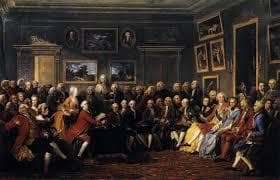
elegant urban drawing rooms where wealthy and middle class people gathered to discuss new ideas
censorship
philosophe
salon
natural rights
20
argued that the planets revolved around the sun, not the earth
Copernicus
Kepler
Galileo
Newton
21
Rousseau argued that society should be governed by the military.
True
False
22
mathematician who showed that the planets were elliptical
Newton
Galileo
Copernicus
Kepler
23
considered father of modern rationalism
Mozart
Diderot
Bacon
Descartes
24
edited his Encyclopedia in order to change how people thought & spread Enlightenment ideas
Smith
Diderot
Locke
Montesquieu
25
laissez-faire is an economic policy that says the state should control the economy
False
True
26
Copernicus, Kepler and Newton's ideas all contributed to this theory of the universe
heliocentric
geocentric
Inductive reasoning
rationalism