stud
bud
Sign up
Log in
Home
Library
Explore
SAT
More
Unit 6: Early Modern Atlantic World Flashcards | StudBud
Explore
/
Unit 6: Early Modern Atlantic World
Unit 6: Early Modern Atlantic World
40 terms
·
StudBud Administration
·
239 plays
#arthistory
Flashcards
40 cards
F
Practice quiz
P
Host live
L
Questions
40
Answers
1
Identify this artwork.
Sistine Chapel. Vatican City. Michelangelo.
Palazzo Rucellai. Florence, Italy. Leon Battista Alberti.
San Carlo alle Quattro Fontane. Rome. Francesco Borromini.
Pazzi Chapel. Florence, Italy. Filippo Brunelleschi.
2
The following are true of this work EXCEPT:
it was made by Lucas Cranach the Elder
it is an etching
it was distributed widely
the artist was friends of Martin Luther
3
This work was made by _________ in/from ________________________.
Botticelli, 1484-1486 CE
Fra Filippo Lippi, 1465 CE
Jacopo Pontormo; 1525-1528 CE
Titian, 1538 CE
4
This Annunciation Triptych was made to function as a
altarpiece in the local church
private altarpiece
meditation device for monks
iconostasis
5
Giotto broke from the Byzantine tradition through all of the following means EXCEPT:
depicting holy figures with golden halos
adding a blue sky
having highly emotive figures and facial expressions
showing figures from the back
6
Identify this artwork.
Jan van Eyck. The Arnolfini Portrait. Oil on wood.
Sandro Botticelli. Birth of Venus. Tempera on canvas.
Titian. Venus of Urbino. Oil on canvas.
The Delphic Sibyl. Sistine Chapel. Michelangelo. Fresco.
7
Giotto's Arena Chapel was commissioned by
Enrico Scrovegni to make up for the sins of his father
the Medicis as a sign of personal piety
the Pazzi family, to show their loyalty to the pope
the Trinitarian monks
8
The German artist Albrecht Durer was inspired by Vitruvian and classical models after visiting
Italy during the High Renaissance
the monastery at Lindisfarne
France during the Baroque era
the Netherlands during the 15th c. Northern Renaissance
9
These figures on the Sistine ceiling were sibyls, or
prophets from the Old Testament
ancient oracles or prophets
goddesses of wisdom
followers of the cult of Mary
10
This work can be attributed to
Vermeer
Peter Paul Rubens
Rachel Ruysch
Pieter Bruegel the Elder
11
Giacomo da Vignola, Gaulli, and Giacomo della Porta contributed to the design and decoration of
San Carlo Alle Cuatro Fontane. Rome, Italy.
Pazzi Chapel. Florence, Italy.
Palazzo Rucelai. Florence, Italy.
Il Gesu. Rome, Italy.
12
The following are true of Las Meninas EXCEPT:
it was innovative for how it engaged the viewer
it was rejected by the patron upon completion
it was commissioned by King Philip IV
it was meant to elevate the status of Diego Velazquez
13
This satirical painting that comments on British middle-class society was made by
Robert Campin
William Hogarth
Bernini
Lucas Cranach the Elder
14
The following are true of Rachel Ruysch EXCEPT:
she was a still life painter and mother to 10 kids
her paintings are considered vanitas paintings
she was a Dutch Baroque artist & her father was a botanist
her medium was fresco
15
Identify this artwork.
Rembrandt. Self-Portrait with Saskia. 1636. Etching.
Robert Campin. Annunciation Triptych. 1427. Oil on canvas.
Diego Velazquez. Las Meninas. 1656. Oil on canvas.
Fra Filippo Lippi. Madonna and Child with Two Angels. 1465.
16
This series was painted by _______ after Marie de' Medici's exile from the French court.
Titian
Raphael
Peter Paul Rubens
Rembrandt
17
The following are true of the Ecstasy of St. Teresa EXCEPT:
the patrons were sculpted on either side of St. Teresa
the artist was a set designer
it is Italian Baroque
it was made by Michelangelo
18
Identify this artwork.
Michelangelo. David. 1501-04. Marble.
Donatello. David. 1440-60. Bronze.
Leonardo da Vinci. David. Bronze.
Bernini. David. 1623-24. Marble.
19
Da Vinci's Last Supper was located in a nun's
radiating chapel
chapel
cloister
refectory
20
This artist depicted the seasons in his series of Northern landscapes.
Lucas Cranach the Elder
Pieter Bruegel the Elder
Robert Campin
Jan van Eyck
21
The Palazzo Rucellai was designed by this architect and author for a Florentine merchant family
Maderno
Brunelleschi
Leon Battista Alberti
Louis le Vau and Jule Hardouin-Mansart
22
This work can be attributed to the Northern Renaissance for the following reasons EXCEPT:
abundance of symbolism in the form of everyday objects
non-religious subject matter
the use of tenebrism
use of oil paints
23
Both Donatello and Michelangelo's David later took up residence at
St. Peter's Basilica
the Cornaro Chapel
the papal library
the Piazza della Signoria (Florence Town Hall)
24
Popes _______ commissioned the sculptor __________ to paint the Sistine ceiling & altar wall.
Julius II & Clement VII; Raphael
Leo III and Julius II; Da Vinci
Clement VII & Leo III; Giotto
Julius II & Clement VII; Michelangelo
25
San Carlo alle Quattro Fontane
broke from the rational order of Renaissance architecture
all of the above
featured an undulating facade
combined a Greek cross and oval plan
26
Identify this artwork
Cornaro Chapel, Church of Santa Maria della Vittoria. 1647.
Louis Le Vau and Jules Jardouin-Mansart. Versailles. 1669.
da Vignola, della Porta. Il Gesu. Rome, Italy. 1568.
Leon Battista Alberti. Palazzo Rucelai. 1450.
27
Rembrandt van Rijn was
Flemish master engraver and painter working in the 16th c.
an Italian Baroque artist working in the 17th c.
a German engraver working in the 15th c.
a Dutch master etcher and painter working in the 17th c.
28
The following are true of this structure designed by Florentine architect Brunelleschi, EXCEPT:
it utilized pietra serena trim
it was commissioned by the Pazzi family
it comes from the Italian Baroque art period
it was based on ancient Roman models such as the Pantheon
29
Identify this artwork.
Jacopo da Pontormo. Entombment of Christ. 1525-28. Oil wood.
Michelangelo. The Flood. Sistine Ceiling. 1508. Fresco.
Matthias Grunewald. Isenheim Altarpiece. 1512. Oil on wood.
Giotto. Arena Chapel. Lamentation. Fresco. 1305.
30
This Madonna by Filippo Lippi
was based on Ancient models
was painted in Venice
demonstrated an evolution towards greater naturalism
demonstrated the new invention of linear perspective
31
The Palace at Versailles featured lots of these motifs in gold!
Venuses
Aphrodites
suns
moons
32
Identify this artwork.
Robert Campin. Annunciation Triptych. 1512.
Caravaggio. Calling of St. Matthew. Oil on canvas.
Matthias Grunewald. Isenheim Altarpiece. Oil on wood.
Leonardo da Vinci. Last Supper. Oil and tempera.
33
This altarpiece was made by
Lucas Cranach the Elder to use for private devotion
Bernini for a private chapel
Matthias Grunewald for a hospital chapel
Matthias Grunewald as decoration for the pope's palace
34
Italian Baroque artist Caravaggio was most renowned for his use of
oil paint glazes
linear perspective
chiaroscuro
tenebrism
35
Identify this artwork.
San Carlo alle Quattro Fontane. Borromini. Rome. 1638
Ecstasy of Saint Teresa. Bernini. Rome. 1647-1652
Triumph of the Name of Jesus. Gaulli. 1676.
Entombment of Christ. Jacopo da Pontomoro. 1525-28.
36
Identify this artwork.
Michelangelo. Sistine Chapel ceiling and altar wall. 1508.
Fra Filippo Lippi. Madonna and Child with Two Angels. 1465.
Albrecht Durer. Adam and Eve. 1504. Engraving.
Leonardo da Vinci. Last Supper. 1494-98.
37
Renaissance humanists sought to
start a protestant revolution
follow Byzantine formulas for representing figures
eliminate icons from sacred spaces
revive and surpass Ancient Greek and Roman cultures
38
Identify this artwork.
Rachel Ruysch. Fruit and Insects. 1711.
Louis Daguerre. Still Life in Studio. 1837.
Kandinsky. Improvisation 28. 1912.
Pieter Clasz. Vanitas. 1710.
39
Identify this artwork.
Self-Portrait with Saskia. Rembrandt. Etching.
Albrecht Durer. Adam and Eve. 1504. Engraving.
Lucas Cranach the Elder. Allegory of Law and Grace. Woodcut.
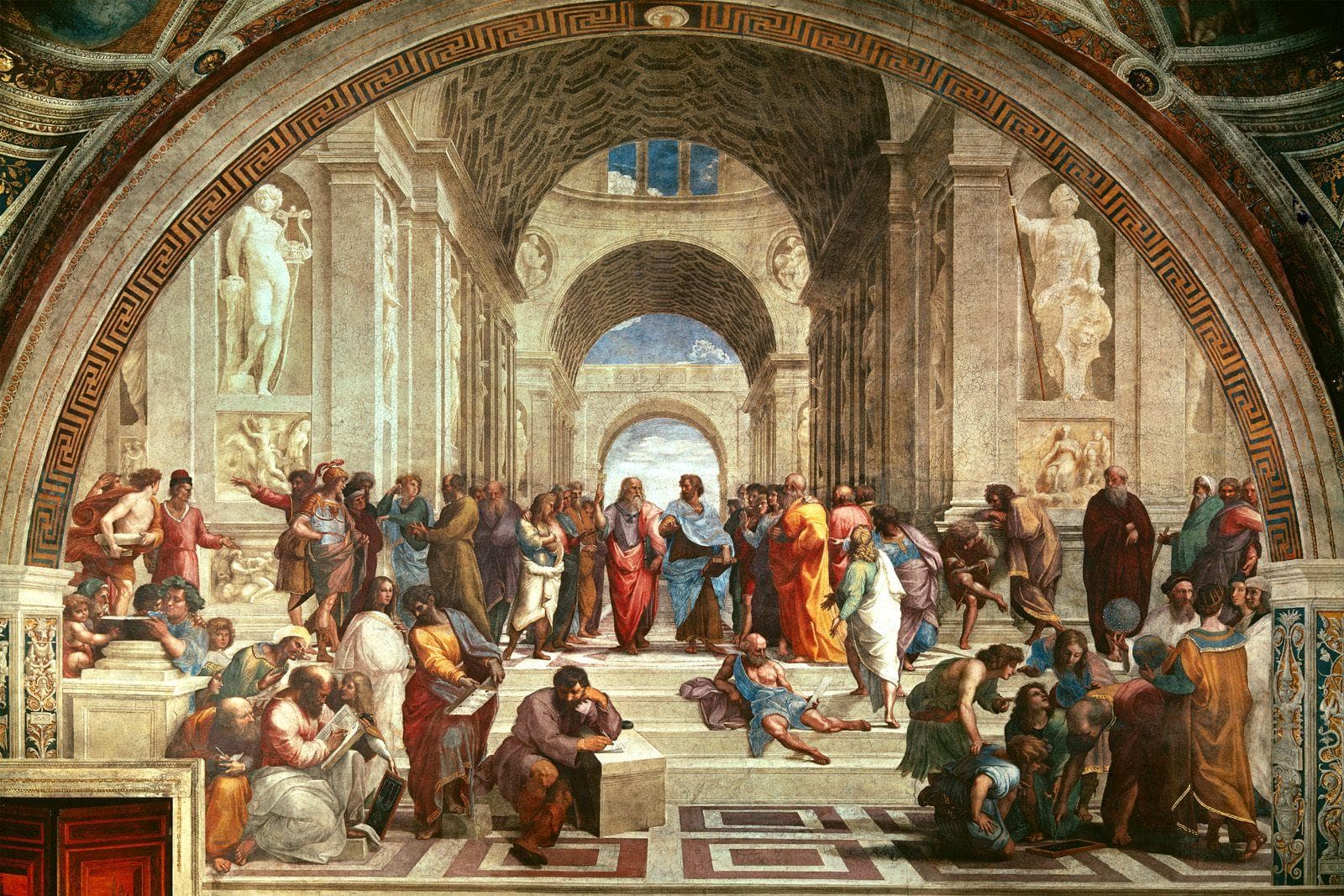
Raphael. School of Athens. 1509-11. Fresco.
40
Flemish contemporaries would have understood this piece by
reading the plaque beneath it
having previously studied the New Testament
reading the symbolism of the everyday items
using a key to decode it