stud
bud
Sign up
Log in
Home
Library
Explore
SAT
More
Formation of the Solar System Flashcards | StudBud
Explore
/
Formation of the Solar System
Formation of the Solar System
16 terms
·
StudBud Administration
·
2,776 plays
Solar System formation review #solarsystem #campos
Flashcards
16 cards
F
Practice quiz
P
Host live
L
Questions
16
Answers
1
What happens when an atom undergoes radioactive decay?
atoms break away from the molecules they are part of
Two atomic nuclei fuse to form a new atomic structure
energy or matter in an atomic nucleus is reduced
Radioactive energy is added into an atomic nucleus
2
How large is Earth in a solar system model where the sun is the size of the bouncy ball?
barely visible
small marble
grain of sand
pencil eraser
3
What theory states the formation of the solar system?
Evolution
Nebular
Chaos
Big Bang
4
Which solar system object is the largest?
Mercury
Neptune
Sun
Jupiter
5
Which conditions on Earth support life?
liquid water, oxygen/carbon dioxide in atmosphere
rotation at the equator, silica rich crust
365 day year, 24 hour day
molten core, semi-solid mantle layer
6
Why is there more H and He gas in the outer Solar System?
didn't solidify close to Sun & solar wind pushed them away
Too heavy to move away from Sun
They were repelled by heavy elements
They froze close to Sun and got pushed by Solar Wind
7
What is the half-life of the Strontium 30?
100 years
75 years
50 years
25 years
8
A solar system contains
a star and more stars
a star and planets
planets and no star
galaxies
9
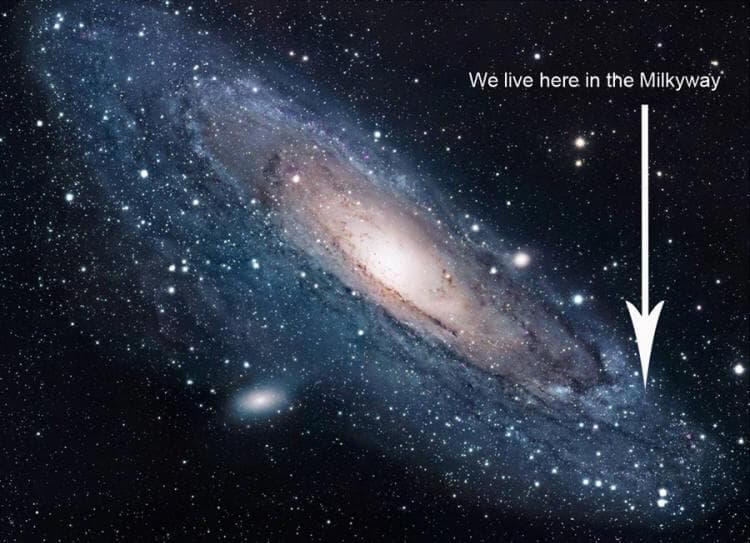
How does the size of the solar system compare to the Milky Way galaxy?
The solar system is about one half the size
The solar system is larger
The solar system is the same size
The solar system is much smaller
10
Why are the outer planets larger?
Cold enough for left gases to solidify and capture H & He
Made from heavy elements
There is more gravity in outer Solar System
Formed in the habitable zone
11
How is the age of the solar system estimated by scientists? By
comparing fossil types
dating radioactive elements
measuring expansion of stars
sequencing rock layers
12
Why are radioactive substances used by scientists to measure the age of Earth?
They can be compared to other substances in therock
They give off radiation at a predictable, steadyrate
They are only found in Earth’s oldest rocks
They are found in all solid substances on Earth
13
Why are the rocky inner planets made of heavier elements?
lighter elements are less dense & sunk toward the Sun
lighter elements are more dense & sunk toward the Sun
heavier elements are more dense & sunk toward the Sun
heavier elements are less dense & sunk toward the Sun
14
How big an area is needed to make a solar system model that has a sun the size of a bouncy ball
city
classroom
state
P.E. field
15
A rock sample is tested and 25% of the original Strontium remains. How old is the rock?
100 years
75 years
50 years
25 years
16
Why are the inner planets made of less hydrogen and helium than the outer planets?
too hot to attract hydrogen & helium
too cold to attract hydrogen & helium
too small to attract hydrogen & helium
too large to attract hydrogen & helium