stud
bud
Sign up
Log in
Home
Library
Explore
SAT
More
Chemistry Atomic Theory Chapter 4 Review Flashcards | StudBud
Explore
/
Chemistry Atomic Theory Chapter 4 Review
Chemistry Atomic Theory Chapter 4 Review
38 terms
·
StudBud Administration
·
1,799 plays
Imported from external platform
Flashcards
38 cards
F
Practice quiz
P
Host live
L
Questions
38
Answers
1
Who discovered the electron?
John Dalton
JJ Thomson
Eugene Goldstein
Ernest Rutherford
2
Who discovered the proton?
JJ Thomson
Robert Millikan
Eugene Goldstein
Ernest Rutherford
3
Who performed the gold foil experiment?
Niels Bohr
JJ Thomson
Ernest Rutherford
John Dalton
4
Who discovered the neutron?
John Dalton
James Chadwick
Ernest Rutherford
JJ Thomson
5
Dalton's atomic theory helped explain the law of conservation of mass because it stated:
atoms could not be created or destroyed
atoms all had the same mass
atoms could not combine
atoms could be subdivided
6
How many electrons are in the following atom?
52
17
18
35
7
Subatomics particles that have no charge:
ions
electrons
protons
neutrons
8
Who proposed the plum pudding model of the atom?
Ernest Rutherford
John Dalton
JJ Thomson
Robert Millikan
9
Who discovered the nucleus?
James Chadwick
JJ Thomson
Ernest Rutherford
John Dalton
10
Atoms of carbon always have 6 protons.
FALSE
TRUE
11
The Greek philosopher to first propose the idea of atoms:
Dalton
Galileo
Democritus
Plato
12
Atoms of the same element can have different mass numbers.
TRUE
FALSE
13
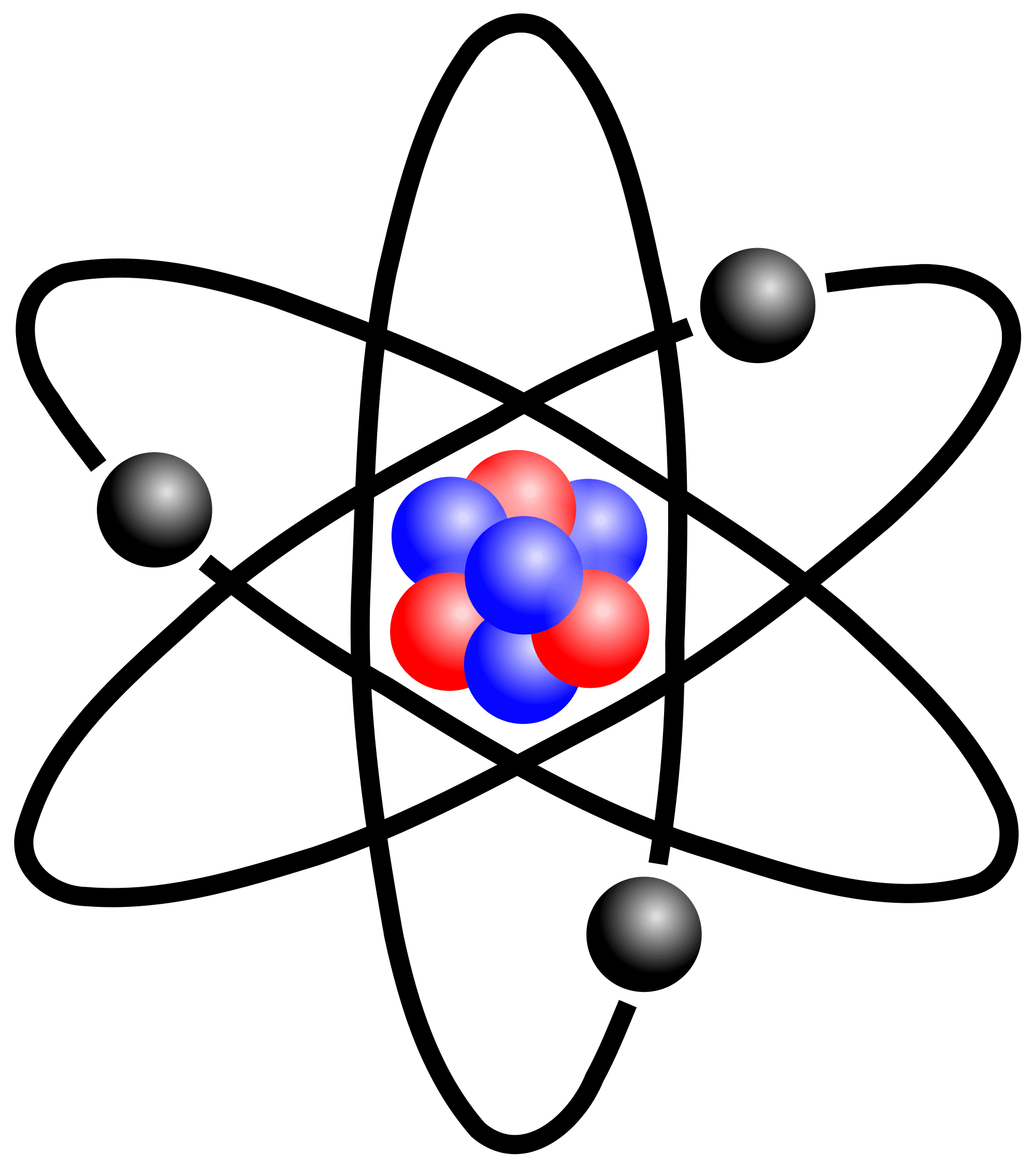
The model of the atom shown in this picture is called:
electron cloud model
plum pudding model
nuclear model
planetary model
14
Subatomic particles that have a negative charge:
electrons
ions
neutrons
protons
15
Who described the atom as "indivisble and indestructable?"
JJ Thomson only
Dalton and Democritus
Democritus only
Dalton and Thomson
16
The first scientist to propose an atomic theory based on experimental evidence was:
Dalton
Democritus
Thomson
Rutherford
17
Subatomic particles found in the nucleus of an atom:
protons, neutrons, and electrons
neutrons and electrons
protons and neutrons
protons and electrons
18
Atoms that have the same number of protons but different number of neutrons are called:
non-existent
isotopes
nucleus
ions
19
The gold foil experiment led to the discovery of the:
electron
nucleus
neutron
proton
20
Subatomic particles that have a positive charge.
electrons
protons
ions
neutrons
21
Who determined the relative mass and charge of an electron?
Niels Bohr
John Dalton
Robert Millikan
Eugene Goldstein
22
How many neutrons are in the following atom?
10
7
3
4
23
An atom has 10 protons, 10 electrons, and 12 neutrons. What is its atomic number?
2
10
12
22
24
Hydrogen - 1 and Hydrogen - 2 are examples of what?
none of the above
ions
isotopes
neutrons
25
Protons and electrons have the same relative mass.
FALSE
TRUE
26
An atom has 13 protons and 14 neutrons. How many electrons does it have?
27
14
1
13
27
Who proposed the nuclear model of the atom?
JJ Thomson
Ernest Rutherford
Democritus
John Dalton
28
Mass number is defined as the number of ____________ in an atom.
protons and neutrons
protons
neutrons
protons and electrons
29
In the atom "nitrogen - 15," what does the "15" represent?
atom
atomic number
atomic mass
mass number
30
An atom has 4 protons, 4 electrons, and 5 neutrons. What is its mass number?
8
5
9
4
31
How many subatomic particles are
in the nucleus
of the following isotope?
84
120
36
48
32
All parts of Dalton's atomic theory are still true today.
FALSE
TRUE
33
Atoms are mostly empty space.
TRUE
FALSE
34
An atom has an atomic number of 5 and mass number of 11. How many neutrons does it have?
5
none of the above
11
6
35
An atomic mass unit (amu) is one-twelfth the mass of a carbon-12 atom.
FALSE
TRUE
36
Most of the mass of an atom is concentrated in the nucleus.
TRUE
FALSE
37
The number of protons in an atom is defined as the:
atomic number
isotope
mass number
atomic mass
38
An atom has 10 protons, 10 electrons, and 12 neutrons. What element is it?
Mg
Ne
Na
Ti