stud
bud
Sign up
Log in
Home
Library
Explore
SAT
More
The Planets and the Outer Solar System Flashcards | StudBud
Explore
/
The Planets and the Outer Solar System
The Planets and the Outer Solar System
30 terms
·
StudBud Administration
·
1,966 plays
This quiz is based on 7th-grade Earth/Space Science curriculum in Florida.
Flashcards
30 cards
F
Practice quiz
P
Host live
L
Questions
30
Answers
1
Which planet has surface gravity most like Earth?
Uranus, 79%
Saturn, 106%
Neptune, 112%
Jupiter, 253%
2
Io, a moon of Jupiter, has the most _________ of any object in the Solar System.
Liquid Water
Iron Oxide
Volcanoes
Ice
3
What distance is an AU (astronomical unit)?
Distance from Sun to Earth
Distance from Mercury to Neptune
Distance from Sun to Asteroid Belt
Distance from Sun to Neptune
4
Which of these planets have
deep
,
massive
atmospheres?
Jupiter, Saturn, Uranus, Neptune
Venus, Mars
Mars, Saturn
Mercury, Jupiter
5
A "shooting star" is really a ______________________ ?
Asteroid
Meteor
Meteoroid
Meteorite
6
Going from the Sun outward, which of these order of planets is incorrect?
Venus-Earth-Mars
Saturn-Uranus-Neptune
Mercury-Venus-Earth
Earth-Mars-Saturn
7
A _________ is a testable idea which leads to a scientific investigation.
Variable
Definition
Guess
Hypothesis
8
This is Olympus Mons, the tallest mountain in the Solar System. What planet is it on?
Earth
Venus
Makemake
Mars
9
Which of the 8 planets has the longest year (orbit of the Sun)?
Mercury
Uranus
Earth
Neptune
10
___________ is collected by scientists to prove their theories.
Empirical Evidence
Excellent Evidence
Extraordinary Evidence
Exact Evidence
11
What gives Mars its red color?
Iron Oxide
Brick Dust
Hydrogen
Helium
12
Which of these is categorized as a terrestrial planet?
Eris
Pluto
Mercury
Neptune
13
What is this object?
meteorite
comet
asteroid
meteor
14
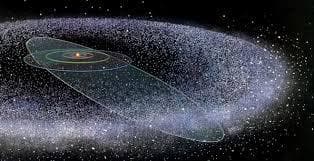
The __________ is a spherical, loose collection of icy objects surrounding the Solar System.
Oort Cloud
Asteroid Belt
Outer Belt
Kuiper Belt
15
Uranus is 19.2 AU from the Sun. It is about ___times farther from the Sun than Earth.
19
3
18
20
16
Which gas gives Uranus and Neptune their blue colors?
Helium
Water Vapor
Hydrogen
Methane
17
Which of these adjectives describes a terrestrial planet?
cold
gaseous
large
rocky
18
What measure of distance should we use inside the solar system?
kilometers
light year
miles
AU
19
Because of its near identical size and gravity, which planet is considered Earth's "sister"?
Venus
Mars
Pluto
Makemake
20
Which feature of the solar system lies between the orbits of Mars and Jupiter?
Kuiper Belt
Asteroid Belt
Meteoroid Belt
Oort Cloud
21
Which of these features of our solar system is located outside the orbits of the Gas Giants?
Ceres
Kuiper Belt
Mercury
Asteroid Belt
22
Mars is farther from the Sun than Earth, so which planet has a longer year (orbit)?
Mercury
Mars
They are the Same
Earth
23
Which of these planets has a solid surface?
Venus
Saturn
Uranus
Jupiter
24
Light travels from the Sun to Earth in about _______________________.
8 hours
8 minutes
8 years
8 seconds
25
Why is Venus hotter than Mercury?
Its incredibly thick atmosphere.
It's closer to the Sun.
Internal Heating
26
Which stars are the hottest?
Red
Blue-White
White
Blue
27
Which planets have the most moons?
Saturn and Neptune
Mars and Jupiter
Jupiter and Uranus
Jupiter and Saturn
28
What caused this crater?
meteor
asteroid
meteorite
meteoroid
29
The variable in an experiment which is changed so it can be tested is the __________ variable.
wild
independent
dependent
controlled
30
Which of these planets is a gas giant?
Pluto
Uranus
Mars
Venus