stud
bud
Sign up
Log in
Home
Library
Explore
SAT
More
Introduction Periodic Table # 1 Flashcards | StudBud
Explore
/
Introduction Periodic Table # 1
Introduction Periodic Table # 1
47 terms
·
StudBud Administration
·
271 plays
review of elements and periodic table structure #periodictable
Flashcards
47 cards
F
Practice quiz
P
Host live
L
Questions
47
Answers
1
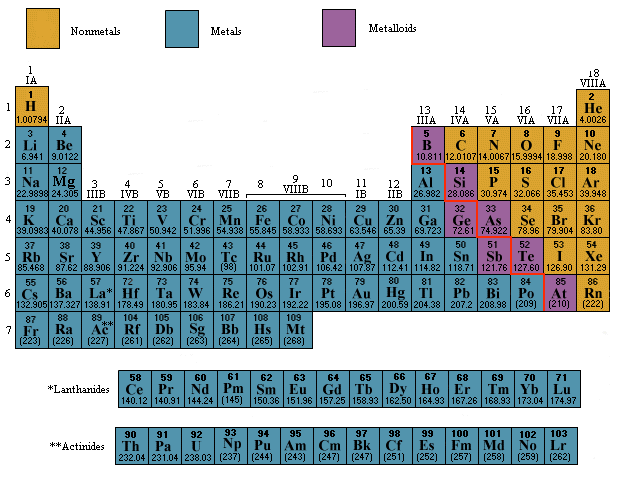
Model that shows the properties of Elements
Punnett Square
Periodic Table
Pedigree chart
Periodic Graph
2
Found in the nucleus of an atom
protons and electrons
protons and neutrons
neutrons and electrons
3
The symbol for Neon
NE
N
No
Ne
4
Malleable means
conduct electricity
can reflect light
hammered into different shapes
5
In the periodic table, the most reactive elements are found in _____.
Group 1, the first column on left
Period 1, the first row on the top
Periods 6 & 7 at the bottom
Groups 13-16 in the center
6
Soluble
solution to a problem
cannot be dissolved
capable of being dissolved
7
Which statement is correct ?
Groups are vertical columns & Periods are horizontal rows
Groups are horizontal columns & periodss are vertical rows
8
A material is ductile if it _____.
can transfer heat or electricity to another metal
can be hammered or rolled into flat sheets
is a mixture of metal with at least one other element
can be pulled or drawn into a long wire
9
which sub atomic particles are found in the vacuole?
none
protons and electrons
protons and neutrons
electrons
10
The location of Helium in the Periodic Table
Group 1
Group 18
Group 2
Group 17
11
How did chemists change Mendeleev's periodic table?
They used atomic mass instead of atomic number.
The used atomic number instead of atomic mass.
They included physical properties like density.
The included chemical properties like bonding power.
12
An element is described as
basic building blocks of matter
made of different atoms
made of only one type of atom
basic building blocks of life
13
Symbol for Copper
CO
Cu
CU
Co
14
The family: Halogens is found
Group 18
Period 2
Group 1
Group 17
15
The atomic number of Iron is
30
26
56
82
16
Sodium has 11 protons, 12 neutrons and 11 electrons. What is it's mass number?
23
22
11
12
17
In an atom, the number of protons equals the number of ____.
neutrons
electrons
isotopes
nuclei
18
Named form the old latin name Aurium
copper
zinc
Gold
Silver
19
The sun is made of mostly what element?
carbon
hydrogen
oxygen
iron
20
The symbol for Helium is
HE
he
H
He
21
Fluorine, chlorine, bromine and iodine are part of a family called _____.
halogens
metalloids
alkali metals
noble gases
22
Which group of elements share characteristics with both metals and non-metals?
halogens
metalloids
salts
lanthanides
23
The only metal that is a liquid at room temperature
Mercury
marcury
water
Mulbury
24
What is unique about noble gases?
exist as solid elements
Don't form compounds
Are non-reactive
form salts
25
If an atom has 15 electrons, how many protons will it have?
30
15
0
20
26
Which statement is incorrect?
Copper is a metal
Helium is a non- metal
Helium is a metal
Sodium is a metal
27
The symbol for gold
Au
AU
Ag
AG
28
Cl is the symbol for the element
Chloride
Chlorine
Carbon
Corine
29
Which particles in atoms have a negative electric charge?
protons
neutrons
nucleus
electrons
30
2 or more substances that are physically combined but retain individual properties.
atom
Mixture
compound
element
31
arrange in term of size from smallest to greatest
atom, element, mixture, compound
atom, element, compound , mixtures
element, atom, compound, mixture
mixture, atom, element, compound
32
example of a solvent
sand
salt
water
33
method that can separate sand and salt
Separation Funnel
Filtration
Evaporation
chromatography
34
What natural event provides enough energy to create elements through nuclear fusion?
a plasma
a supernova
a nebula
a particle accelerator
35
2 or more substances that are chemically combined
element
compound
Mixture
36
Which scientist designed the modern Periodic Table?
Maslow
Galileo
Newton
Mendeleev
37
Which of the following is NOT a property common to non-metals?
reactive with other elements
brittle
conduct electricity easily
dull
38
Where is zinc located in the Periodic table
Group 18 Period 4
Group 12 Period 5
Group 4 Period 12
Group 12 period 4
39
Which of the following statements about metals is true?
Metals do not react with oxygen
Metals show a wide range of chemical properties
Metals are highly reactive
Metals need to be stored in sealed containers for safety
40
How does the atomic mass of the elements change as you move from top to bottom on the table?
Stays the same
Mass decreases
Mass increases
41
Family name for Group 18
Halogens
Alkali earth metals
Noble gases
Alkali metals
42
The elements in a column of the periodic table ____.
have similar chemical symbols
have the same atomic mass
have similar properties
are in the same period
43
Which group contains the most elements?
transition elements
metals
non-metals
metalloids
44
Mendeleev created the first periodic table by arranging the elements in order of _____.
increasing melting points and densities
increasing atomic mass
decreasing atomic mass
increasing atomic number
45
Elements that are to the left of the Periodic table are normally metals
True
Don't know
False
46
The first element in Period 2
lithium
sodium
hydrogen
magnesium
47
What information in the periodic table indicates the number of protons in an atom?
the element's chemical symbol
the element's atomic number
the element's atomic mass
the position of the element in the column