stud
bud
Sign up
Log in
Home
Library
Explore
SAT
More
Plate Tectonics Flashcards | StudBud
Explore
/
Plate Tectonics
Plate Tectonics
30 terms
·
StudBud Administration
·
648 plays
Imported from external platform
Flashcards
30 cards
F
Practice quiz
P
Host live
L
Questions
30
Answers
1
A plot of the positions of Earth's magnetic poles over time reveals a pattern referred to as
magnetic drift
polar spreading
perturbation
apparent polar wandering
2
Which of these was not a piece of evidence that was used to support Continental Drift theory?
Fit of the continents
None of these
Mountain ranges
Identical fossils on different landmasses
3
This is an example of what type of plate boundary?
Divergent
Transform
Collision
Convergent
4
This is an example of what type of plate boundary?
Collision
Convergent
Transform
Divergent
5
The upward motion of hot rock and mantle materials is found only at oceanic ridges.
False
True
6
Normal and reverse magnetism of ocean rock reveals ________________ pattern
a random
a mirror image
no
7
The name of the supercontinent that Wegener thought was made up of all continents was called
Euroamerica
Atlantis
Pantheon
Pangaea
8
Why does Layer D descend beneath Layer C?
It is more dense
It is moving faster
It is less dense
It is not descending
9
Most of Earth's seismic activity, volcanism, and mountain building occur along
random trends
plate boundaries
hot spots
lines of magnetism
10
Which of the following is not evidence Wegener presented in the early 1900s?
Fit of Africa and South America
Mesosaurus fossils
Lithospheric Plates
Rock structures in South America and Africa
11
The age of the Hawaiian Islands
is random in relation to the Big Island of Hawaii
decreases away from the Big Island of Hawaii
is constant for all islands
increases away from the Big Island of Hawaii
12
Current models for mantle convection indicate convection may occur
throughout the whole mantle
within the lower mantle
within the asthenosphere
all of these
13
During the past 4 million years, Earth's magentic field has reversed
twice
hundreds of times
thousands of times
several times
14
Who is this scientist who first proposed the Continental Drift theory?
Alfred Wegener
James Hutton
Drummond Matthews
Harry Hess
15
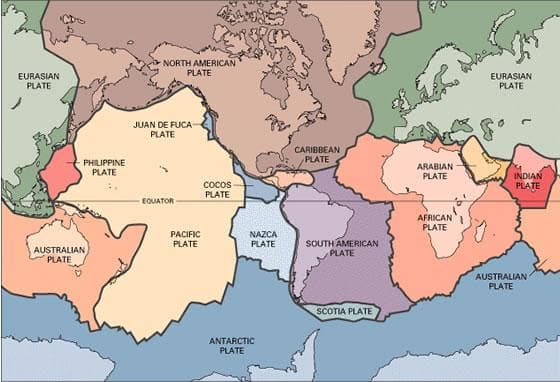
The theory of Plate Tectonics hold's that Earth's lithosphere is broken into about ___ plates.
20
30
10
5
16
The seafloor spreading hypothesis is supported by
the age of sediments in relation to the ridges
the pattern of magnetic anomalies
all of these
drilling of the seafloor
17
Which color of seafloor represents the oldest rock samples in the ocean basins?
Blue
Yellow
Red
Green
18
Seafloor spreading has produced the Atlantic Ocean floor during the past ~180 million years.
True
False
19
Which type of boundary is illustrated here?
Transform
Collision
Convergent: Ocean to Ocean
Convergent: Continent to Ocean
20
Which type of boundary is illustrated here?
Transform
Hot Spot
Divergent
Collision
21
This scientist's work developed into the Seafloor Spreading hypothesis?
Harry Hess
James Hutton
Drummond Matthews
Alfred Wegener
22
Where on Earth are the most rapid rates of seafloor spreading?
Phillipines
Mid Atlantic Ridge
Pacific Rise
Red Sea
23
Which type of boundary is illustrated here?
Collision
Convergent: Continent to Ocean
Transform
Divergent
24
What does Letter E represent in this diagram?
Continental crust
Core
Oceanic crust
Asthenosphere
25
Typical rates of seafloor spreading average around _______ centimeters per year.
10
15
5
20
26
What does Letter C represent in this diagram?
Oceanic crust
Continental crust
Core
Asthenosphere
27
The relative plate motions show North America is moving away from Europe at a rate of about
1 meter / yr
2 centimeters / yr
10 centimeters / yr
5 centimeters / yr
28
The main reason that Continental Drift theory was largely dismissed.
There was a more popular theory of the time
Wegener died before his research could be published
Lacked a mechanism for continents to move
None of these
29
Possible sources of heat for Earth's interior include
all of these
collisions with objects
radioactive decay
original heat of formation
30
Most deep focus earthquakes occur in association with
oceanic ridges
hotspots
transform boundaries
ocean trenches