stud
bud
Sign up
Log in
Home
Library
Explore
SAT
More
Unit 2 Test Review 2019 Flashcards | StudBud
Explore
/
Unit 2 Test Review 2019
Unit 2 Test Review 2019
23 terms
·
StudBud Administration
·
185 plays
A #chemistry review on the #atom
Flashcards
23 cards
F
Practice quiz
P
Host live
L
Questions
23
Answers
1
When the frequency of a wave INCREASES, the energy of that wave ___________.
stays the same
fluctuates
increases
decreases
2
See equations on white board. What is the energy of a wave with a frequency of 6.2 x 10
14
Hz?
4.1 x 10⁻¹⁹ J
2.9 x 10⁻¹⁹ J
8.1 x 10⁻¹⁸ J
9.4 x 1047 J
3
An emission spectrum is created by the movement of which particles?
Protons
Neutrons
Nuclei
Electrons
4
In the isotope notation for this copper atom, the "29" represents its __________.
charge
energy level
mass number
atomic number
5
The atomic number of an element is the same as its number of
electrons
ions
protons
neutrons
6
An atom of sodium (Na, atomic number 11) has a mass number of 25. How many neutrons does this Na atom have?
11
13
12
14
7
The mass number of an element is the total number of
electrons + neutrons
electrons + protons
protons + neutrons
electrons
8
A neutral atom of lithium (Li, atomic number: 3) has _____ electrons.
6.941
3
7
0
9
When an atom emits light, what is happening to the electrons?
Its electrons are absorbing energy (moving up in levels)
Its electrons are releasing energy (moving down in levels)
Its electrons are standing still
Its electrons are leaving the atom
10
In today's atomic theory,
the electrons move around the nucleus clockwise
the atom looks like cookie dough with electrons mixed in
the electrons orbit the nucleus like planets
the electrons move within an electron cloud
11
Which subatomic particles are found in the nucleus?
Electrons and neutrons
Protons and neutrons
Protons and electrons
Neutrons only
12
What happens when an electron in the excited state falls back to the ground state?
The atom becomes a different element
It moves up in energy levels
Light is released
Heat is absorbed
13
Out of the following, which form of electromagnetic radiation has the HIGHEST frequency?
infrared
microwave
ultraviolet
visible light
14
Dalton's Atomic Theory had several parts to it. Which part below is considered CORRECT?
atoms are combined in whole-number ratios to form compounds
atoms are indivisible (cannot be divided)
none of the above.
atoms of the same element are always identical
15
Which of these happens when an electron absorbs energy and becomes EXCITED?
The electron moves to the energy level closest to the nucleus
The electron loses its charge
The electron falls to a lower energy level
The electron jumps to a higher energy level
16
In a neutral atom, the number of electrons is equal to the number of ___________.
energy levels
none of the above
protons
neutrons
17
Which of these describes the nuclear model of the atom?
Electrons embedded in evenly-distributed positive charge
Small, dense nucleus surrounded by empty space for electrons to move
An undefined region of space where electrons are likely to be found
Hard sphere that can't be divided into anything smaller
18
Which list CORRECTLY orders these EM radiations from SHORTEST to LONGEST wavelength?
gamma ray, ultraviolet, microwave, radio
radio, microwave, ultraviolet, gamma ray
gamma ray, microwave, ultraviolet, radio
ultraviolet, microwave, gamma ray, radio
19
See equations on white board. What is the wavelength of a wave with a frequency of 1.5 x 10
15
Hz?
7.3 x 10⁻⁹ m
8.2 x 10⁻⁶ m
2.0 x 10⁻⁷ m
1.5 x 10⁻⁷ m
20
The collection of every wavelength of light that can be emitted by an element is that element's _____________.
Emission spectrum, which is the same as all other elements
Ground state, which is unique to that element
Emission spectrum, which is unique to that element
Ground state, which is the same as all other elements
21
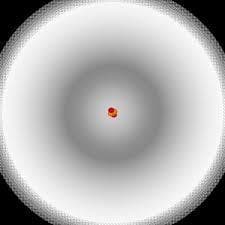
Where are the electrons located in this atom?
the gray area around the center
This atom has no electrons
the center
22
An atom of calcium has 20 protons, 21 neutrons, and 20 electrons. What is its mass number?
40
20
41
21
23
Which one of these forms of electromagnetic radiation has the SHORTEST wavelength?
ultraviolet waves
radio waves
infrared waves
gamma rays