stud
bud
Sign up
Log in
Home
Library
Explore
SAT
More
7th grade, Weather and Climate, ch. 4 Flashcards | StudBud
Explore
/
7th grade, Weather and Climate, ch. 4
7th grade, Weather and Climate, ch. 4
44 terms
·
StudBud Administration
·
2,687 plays
7th grade, Weather and Climate, ch. 4
Flashcards
44 cards
F
Practice quiz
P
Host live
L
Questions
44
Answers
1
Regions that receive less than 25 cm of rain anually are called
savannas
deserts
steppes
tundras
2
The side of the mountain that receives most of the precipitation
windward
leeward
3
Cholorine atoms in the stratosphere
break down ozone into oxygen atoms
increase the amount of ozone
combine with oxygen to form poisonous gases
prevent light from passing through the ozone layer
4
What is the independent variable and where is it located?
It is the manipulated variable and on the X axis
It is the responding variable and on the Y axis
5
GLOBAL WARMING is the trapping of energy from the sun by Earth's atmosphere
false
true
6
Increased carbon dioxide may cause global warming by
allowing more sunlight into the atmosphere
reflecting more sunlight from clouds
reducing the amount of oxygen in the air
trapping more heat in the atmosphere
7
During an ice age, Earth's sea level
lowers
rises
remains unchanged
rises and lowers rhythmically
8
Summers are caused by
a combo of longer days and more direct rays from sun
less direct rays from sun
longer days and longer nights
Earth in its orbit moving closer to sun
9
Permafrost and mosses, lichens, and wildflowers are common in the
ice cap climate
temperate climate
tundra climate
subtropical climate
10
The main factors that affect an area's TEMPERATURE are prevailing winds and mountains
true
false
11
What is the density of pure water?
1 mL
10 g/cm3
1 g/cm3
10 cm3
12
Scientists assume an organism's ancestors required a climate SIMILAR TO present day climate
false
true
13
The seasons are caused by
shifting climates on Earth's surface
Earth's varying distance from the sun
Earth's changing rate of rotation
the tilt of Earth's axis as Earth revolves around sun
14
The avg. year after year conditions of temp, precip, winds, and clouds in an area is known as
global warming
seasons
weather
climate
15
The most recent major ice age in N. America extended as far south as
southern Texas and Florida
Nebraska and Iowa
northern Minnesota and Wisconsin
New Mexico and Oklahoma
16
Some scientists theorize that continental movements may cause climate change by
changing patterns of winds and ocean currents
redistributing Earth's vegetation
altering the makeup of the troposphere
shifting equatorial and temperate zones
17
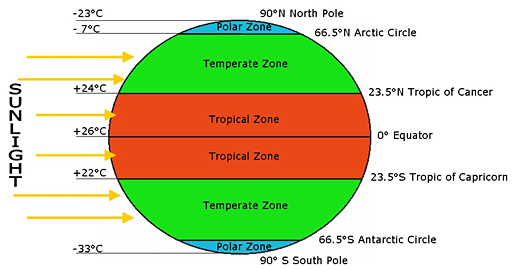
The climate zones lying between 23.5 and 66.5 degrees N and S latitude are called the
polar zones
subtropical zones
tropical zones
temperate zones
18
Temperate CONTINENTAL climates have cold winters
true
false
19
Over the past 200 years, the level of carbon dioxide in the atmosphere has
decreased slightly
increased steadily
increased until recently, and then decreased
stayed the same
20
The Great Plains east of the Rocky Mountains have a
humid contental climate
temperate marine climate
arid climate
semiarid climate
21
Oceans make the temperatures of nearby land MORE extreme
true
false
22
Scientists predict that banning the use of CFC's will
gradually restore the ozone layer
increase the rate of ozone depletion
increase ultraviolet light reaching Earth
have no effect on the ozone layer
23
An El Nino event typically occurs every
1-4 years
2-7 years
7-10 years
year
24
Which of the following do scientists think will probably cause Earth's next ice age?
changes in Earth's orbit and the tilt of its axis
continental drift
an increase in sun spots
several major volcanic eruptions
25
What is the dependent variable and where is it located?
It is the manipulated variable and on the X axis
It is the responding variable and on the Y axis
26
As the amount of ozone decreased, the amount of ultraviolet radiation that reaches us INCREASED
true
false
27
The climate on the leeward side of a mountain differs from that on the windward side mostly in
the amount of rainfall
the strength of the winds
the direction of the winds
the angle of sunlight
28
If an organism today needs certain conditions, then organisms in the past need the same cond.
false
true
29
El Nino is a weather pattern that forms in the
Polar Atlantic Ocean
Tropical Pacific Ocean
Tropical Atlantic Ocean
Polar Pacific Ocean
30
Earth's ozone layer
has been thickening over last few years
filters harmful ultraviolet radiation
exists only over Antarctica
traps carbon dioxide in the stratosphere
31
A temperate continental climate with short cool summers and long, bitterly cold winters is the
tundra climate
humid continental climate
subarctic climate
polar climate
32
The sun's rays are least direct
at high altitudes
far from the ocean
near the equator
near the poles
33
Climates are classified according to two major factors:
elevation and precipitation
elevation and latitude
latitude and temperature
precipitation and temperature
34
An arid or semiarid climate occurs where precip is GREATER than potential evaporation
true
false
35
When glaciers melted after the last ice age, the sea level became HIGHER
true
false
36
In winter in the S Hemisphere, the south end of Earth's axis is tilted AWAY FROM the sun
true
false
37
In addition to temp and precip, Koppen's climate system classified climates by a region's
vegetation
seasonal winds
air masses
microclimates
38
The farther you live from an ocean, the more likely your climate will be a
continental climate
tropical climate
subtropical climate
marine climate
39
Over the last 120 years, the average temp. of the troposphere has DECREASED
true
false
40
A tropical wet climate exists in the United States only in
Hawaii
Florida
California
Oregon and Washington
41
The three kinds of temperate marine climates ALL have
severe winters
mild winters
rainy summers
little rainfall and high temperatures
42
Near the end of both March and September
spring begins in both hemispheres
neither end of Earth's axis is tilted toward the sun
sun's rays strink Earth with the same intensity everywhere
Earth's axis is no longer pointing at the N. Star
43
Clues to what ancient climates were like come from all of the following EXCEPT
ancient pollens
very old weather records
fossil tree rings
fossil trees
44
Sea and land breezes over a large region that change direction with the season are called
savannas
monsoons
prevailing westerlies
doldrum winds