stud
bud
Sign up
Log in
Home
Library
Explore
SAT
More
APAH: All of Asia Flashcards | StudBud
Explore
/
APAH: All of Asia
APAH: All of Asia
50 terms
·
StudBud Administration
·
49 plays
AP Art History Review - West and Central Asia, Indian and SE Asia, China, Korea, and Japan
Flashcards
50 cards
F
Practice quiz
P
Host live
L
Questions
50
Answers
1
What does the work reflect?
The complex journey of gaining spiritual enlightenment
The intermingling of Buddhism and politics in early Japan
Cosmic Buddhist imagery
The development of Japanese architecture throughout history
2
What do Angkor Wat and the Forbidden City have in common?
Both monuments contained a moat
The plans of each monument are largely symmetrical
They are both located in China
They were built using wood
3
When were these created?
Yuan Dynasty, 1351 CE
Ming Dynasty, 1531 CE
Ming Dynasty, 1351 CE
Ching Dynasty, 1351 CE
4
The Taj Mahal
was made to honor a prince
was meant to resemble an Islamic paradise
is faced in white stucco
5
Define the word "mihrab"
a short flight of steps used by a preacher in a mosque
a symbolic doorway indicating which direction to pray
tower attached to a mosque used for the call to prayer
a niche in the wall of a mosque that indicates the qibla
6
The mosque shown is...
Great Mosque at Córdoba
Mosque of Selim II
the Kaaba
Great Mosque at Isfahan (Friday Mosque)
7
The Bamiyan Buddhas experienced a type of _________ at the hands of the Taliban.
iconoclasm
renaissance
regeneration
spolia
8
What religion is practiced in this location?
Buddhism
Shintoism
Hindusim
Islam
9
This architecture originally served as a...
Shrine
Cathedral
Tomb
Mosque
10
Identify this image
Buddha, Bamiyan, Afghanistan, 400-800 BC
Pyxis of al-Mughira, 968 CE
Jowo Rinpoche, Tibet, 641 CE
The Kabba, 631-632 CE
11
The fixture in the lower right hand corner of this image is a(n)
Ablution fountain (Wudu area)
Plinth
Mihrab
Minaret
12
What temple does this Buddha belong in?
Todai-ji
Angkor Wat
Borobundur
Longmen Caves
13
What religion is practiced at this location?
Daoism
Islam
Buddhism
Hinduism
14
The following are true of the temples at Angkor EXCEPT:
Angkor Thom features images of Jayavarman as Shiva
they were constructed by different Khmer kings
they were built in Cambodia
Angkor Wat was built to resemble Mt. Meru
15
This piece demonstrates influences from all of the following places or ideologies EXCEPT:
North Africa
Europe
China
Islam
16
The Forbidden City included all of the following EXCEPT:
a lavish throne room
a moat
public gardens
a 30 ft high wall
17
Which of the following is the most sacred site of Islam?
the Kaaba
Folio from a Qur'an
Great Mosque at Isfahan
Dome of the Rock
18
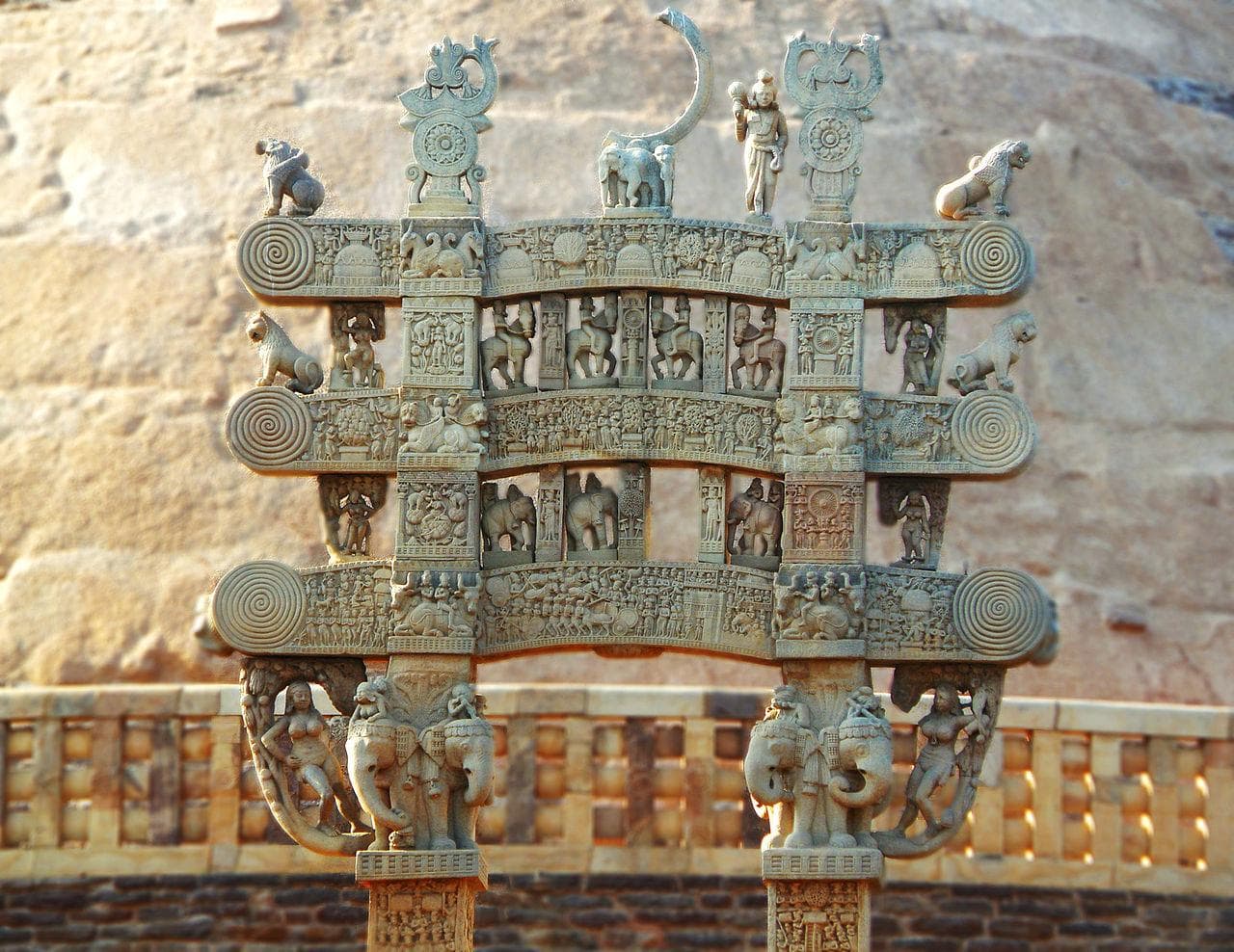
The Great Stupa at Sanchi was made during this time period
1200-1500 CE
400-800 CE
300 BCE-100 CE
1500 BCE
19
This piece's primary function was to
Serve as a garment in the afterlife
Celebrate a person's life upon their death
Guarantee a person's safe passage to the next world
Warn potential grave robbers against stealing from the tomb
20
The entrance of Angkor Thom is a
keystone arch
rock-cut arch
ashlar arch
corbeled arch
21
This Buddhist site demonstrates how Buddhism spread from India to China on the silk road
Angkor Thom
Nan Madol
Longmen Caves
Borobudur
22
Where is this Buddhist temple located?
Borobundur
Lakshmana
Angkor Wat
Todai-ji
23
This ended up in what country where it was used in baptisms of those born to the royal family
France
Japan
Spain
Iran
24
The following are true of these gardens EXCEPT:
the resemble large-scale natural formations found in nature
they are located in Nara, Japan
they are Zen gardens
they are asymmetrical
25
What does this crown symbolize?
a dragon symbolizing Daoist principles
Vines and flowers symbolizing a connection to growth
Mt Meru
a sacred tree symbolizing axis mundi (center of the world)
26
The following are true of Jowo Rinpoche EXCEPT:
it is in its original state
it is a pilgrimage destination for Tibetan Buddhists
it sits in the Jokhang temple in Lhasa, Tibet
the historical Buddha supposedly modeled for it
27
All the following are associated with this structure EXCEPT
communal and personal veneration to Hindu gods
representing the mythical Mount Meru
sacred movement through circumambulation
symbolizing the three worlds of Buddhist cosmology
28
Identify this work
Folio from a Qur’an. 8th to 9th Century
The Court of Gayumars, Shah Tahmasp’s Shahnama. 1522-25 CE.
Basin (Baptistere de St. Louis). c 1320-1340 CE.
The Ardabil Carpet. Maqsud of Kashan. 1530-1540 CE.
29
The David Vases were located in a
Buddhist stupa
Daoist temple
Hindu temple
grave mound
30
The Bamiyan Buddhas in Afghanistan were originally
visited by Buddhist monks
all of the above
painted
accompanied by caves with murals
31
All of the following are present in this monument EXCEPT:
Offerings for a sun deity
Toranas
A reliquary
Horror vacui
32
Where is this Buddha located?
Todai-ji Temple
Borobudur Temple
Great Stupa at Sanchi
Longmen Caves
33
Travelers Among Mountains and Streams and Portrait of Sin Sunkju were both made using
oil paint on canvas
ink on rice paper
ink on silk
woodblock printing
34
Chinese blue and white porcelain was a result of
trade between China and Iran, in the Mongol empire
Iranian potters exporting Chinese-inspired wares
the influence of Dutch delftware
the development of Prussian blue in Europe
35
Which of the following is a site revered by Islam, Christianity, and Judaism?
Basin (Baptistère de St. Louis)
Dome of the Rock
The Alhambra
the Kaaba
36
The movement of ideas and goods across Asia was fueled by
The Black Plague
The Silk Road
The Mongol Invasions
Messenger birds
37
The materials used in the production of this suggest...
its use by common worshippers.
the significance of the recitation on this page.
the wealth of the patron and dignity of the text.
the size of the workshop used in its production.
38
The patron of the Taj Mahal was
Ustad Ahmad Lahori
Shah Jahan
Mao Zedong
Bichitr
39
This folio from an 8th or 9th century Qur'an...
is read from right to left
is illuminated
is written in Kufic script
all of the above
40
What did the three horizontal sections of the Funeral Banner of Lady Dai represent?
Air, Earth, & Water
Childhood, Adulthood, & Old Age
Life, Death, & Rebirth
Heaven, Earth, & the Underworld
41
This object contains all of the following EXCEPT
Horror vacui
Imagery of aquatic animals
Verses from the Qur'an
The crafter's name
42
The themes depicted in this illustrated
Shahnameh
are:
Islamic tolerance of Christianity and political power.
Asian influences and Christian tolerance.
political power and intercultural exchange.
defeat of Chinese by the Mongols and religious tolerance.
43
The following are true of Todai-Ji EXCEPT:
it contains the largest metal cast Buddha in the world
it is a Buddhist temple
it is in its original form
it was a part of the Emperor's plan to unite Japan using religion
44
What aspect of this portrait denotes Sin Sukju's rank?
The Badge on His Robe
The Colors of his Robe
The Hat He Wears
His Seated Position
45
In Zen rock gardens, white gravel often symbolizes these elements
Islands, shores, bridges
Cliffs, mountains, or valleys
Mountains, waves, boats
Clouds, rivers, creeks, or sea
46
The Hall of Supreme Harmony comes from this complex that was made in this time period
Forbidden City, 10th c. CE
Angkor Wat, 1400-1800 CE
Forbidden City, 15th c. CE
Angkor Wat, 900-1400 CE
47
Borobudur is most similar in form and function to
Lakshmana Temple
Great Stupa at Sanchi
Longmen Caves
the Taj Mahal
48
The landscapes of Fan Kuan are a combination of Buddhist ideas and ____________ philosophies.
Confucian
Hindu
Muslim
Daoist
49
All of the following are true of this piece EXCEPT:
It is cast bronze
It depicts Vishnu
It is from the Hindu tradition
The figure has mudras
50
This funeral banner was made for ___________________ during the ______ dynasty.
Devi, Han
Lady Dai, Qin
Lakshmi, Qin
Lady Dai, Han