stud
bud
Sign up
Log in
Home
Library
Explore
SAT
More
Periodic Table Review -- Trends, Configurations, Organization Flashcards | StudBud
Explore
/
Periodic Table Review -- Trends, Configurations, Organization
Periodic Table Review -- Trends, Configurations, Organization
15 terms
·
StudBud Administration
·
237 plays
Review of periodic table trends, electron configuration
Flashcards
15 cards
F
Practice quiz
P
Host live
L
Questions
15
Answers
1
Which of the following is a characteristic of nonmetals?
luster
brittle
malleable
conductor
2
What group is calcium in?
Alkali metals
Group 14
Transition metals
alkaline earth metals
3
Groups/families are represented by
Class
Rows
Periods
Columns
4
Which of the following is a member of the noble gas family and in the sixth energy level?
Rn
Ne
Kr
Xe
5
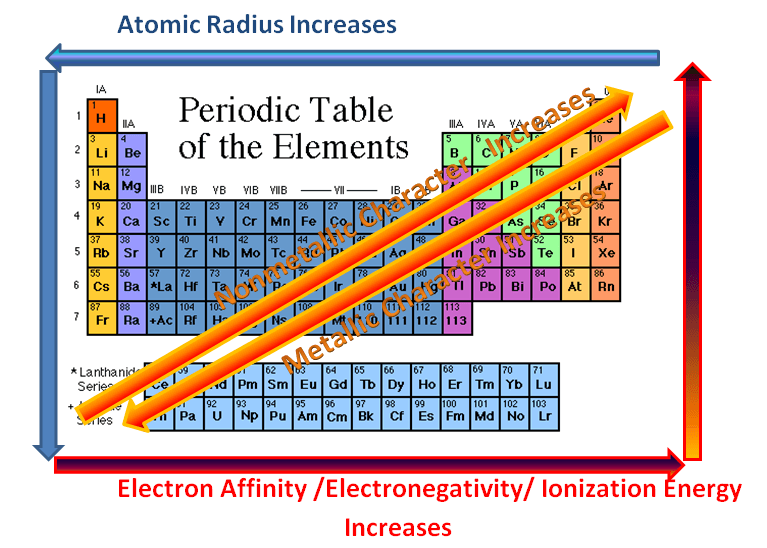
Arrange the following in order of increasing ionization energy.
Al, Ga, In
In, Ga, Al
Ga, Al, In
Ga, In,Al
6
Arrange the following elements in order of increasing electronegativity.
F, N, Be
N, Be, F
Be, N, F
N, F, Be
7
Which of the following is a metal?
Hydrogen
Calcium
Silicon
Chlorine
8
Which of the following is a metalloid?
Al
Zn
P
Ne
9
______________ decreases as you move across a period.
ionization energy
atomic radius
atomic number
electronegativity
10
Nonmetals are found ________ the stair step line on the periodic table.
everywhere
to the LEFT of
ON
the the RIGHT of
11
Atomic radius increases as you move down a group because...
electronegativity decreases
energy levels increase
atomic number decreases
ionization energy increases
12
The periodic table is arranged by increasing...
atomic mass
atomic number
isotope energy
atomic radius
13
Mendeleev's periodic table was unique because...
It included isotopes
it left space for undiscovered elements
He discovered the nuclei of atoms
Who's Mendeleev?
14
What is the correct electron configuration for phosphorous?
1s22s22p63s23p3
1s22s22p53s23p3
1s22s22p3
1s22s22p63s13p3
15
Electronegativity is best described...
the ability to attract electrons
size of the atom
ability to form bonds
the ability to take electrons away