stud
bud
Sign up
Log in
Home
Library
Explore
SAT
More
Narrative Structure Flashcards | StudBud
Explore
/
Narrative Structure
Narrative Structure
35 terms
·
StudBud Administration
·
118 plays
Imported from external platform
Flashcards
35 cards
F
Practice quiz
P
Host live
L
Questions
35
Answers
1
The sequence of events in a story. It includes five major parts.
Setting
Plot
Narrative Structure
Conflict
2
The author's style of writing.
Mood
Voice
Don't Pick This One
Tone
3
The feeling created in the reader by a literary work (atmosphere).
Voice
Connotation
Mood
Tone
4
The writer's attitude toward his or her audience or subject.
Voice
Mood
Tone
Perspective
5
The perspective or vantage point of the story.
Tone
Point of View
Plot
Setting
6
Anything that stands for or represents something else.
Symbol
Sub Plot
Plot
Suspense
7
When something unexpected happens.
Verbal Irony
Dramatic Ironty
Situational Irony
Personal Irony
8
A scene within a story that interrupts and relates events that occurred in the past.
Suspense
Irony
Flashback
Foreshadowing
9
The author's use of clues to hint what might happen later in the story.
Foreshadowing
Flashback
Irony
Tone
10
The writer depends on the reader to draw conclusions about the character's traits.
Direct Characterization
Inference
Mood
Indirect Characterization
11
A fully developed character that exhibits many traits.
Static Character
Flat Character
Round Character
Dynamic Character
12
The narrator knows and tells about what each character thinks and feels.
First Person
Third Person Omniscient
Third Person Limitied
Second Person
13
One-sided and often stereotypical characters
Static Characters
Round Characters
Dynamic Characters
Flat Characters
14
A character who changes or grows throughout the course of a story.
Round Character
Static Character
Dynamic Character
Flat Character
15
Relates the thoughts and feelings of only one character (narrator is not the character)
First Person
Second Person
Third Person Limited
Third Person Omniscient
16
A generalization about human beings or about life. The lesson readers learn.
Irony
Personification
Theme
Supporting Detail
17
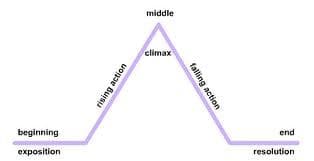
The part of a story where the conflict is developed and increased.
Falling Action
Exposition
Rising Action
Resolution
18
A feeling of anxious uncertainty about the outcome of events in a story.
Flashback
Drama
Irony
Suspense
19
The time and place of a literary work. It also includes the weather.
Setting
Plot
Exposition
Resolution
20
Told by the character. The character is the narrator. Uses the pronoun, "I."
First Person
Second Person
Third Person Omniscient
Third Person Limited
21
Introduction in a story or drama that includes the characters, setting, and basic situation.
Exposition
Climax
Resolution
Rising Action
22
What word describes qualities, attitudes, or values that a character has or displays.
Character Traits
Climax
Setting
Conflict
23
When the author states the character's traits or characteristics.
Conflict
Indirect Characterization
Character
Direct Characterization
24
A struggle with an outside force such as another person or the forces of nature.
Innate Conflict
Internal Conflict
Extreme Conflict
External Conflict
25
What is the turning point in a story called?
Conflict
Climax
Characters
Setting
26
The outcome of the conflict in the plot.
Resolution
Falling Action
Exposition
Rising Action
27
The pattern the story's plot follows and any devices used to move the plot forward
Elements
Plot
Not this one
Narrative Structure
28
Saying the opposite of what you mean (sarcasm)
Dramatic Irony
Situational Irony
Verbal Irony
Blah Blah Blah
29
A struggle within the mind of a character.
Interpersonal Conflict
Internal Conflict
Insane Conflict
External Conflict
30
Tells a story.
Plot
Irony
Narrative
Conflict
31
A story within a story that usually meets up with the main plot of the story.
Exposition
Sub Plot
Plot
Resolution
32
When the reader of a story knows something that the characters in the story do not.
Visualization
Verbal Irony
Dramatic Irony
Situational Irony
33
The events that happen after the climax.
Rising Action
Resolution
Exposition
Falling Action
34
A character that does not change throughout the course of the story.
Round Character
Static Character
Dynamic Character
Flat Character
35
A struggle between opposing forces is called
Conflict
Character
Climax
Setting