stud
bud
Sign up
Log in
Home
Library
Explore
SAT
More
Duplicate of Chapter 9 Lesson 1 the Great Depression Flashcards | StudBud
Explore
/
Duplicate of Chapter 9 Lesson 1 the Great Depression
Duplicate of Chapter 9 Lesson 1 the Great Depression
12 terms
·
StudBud Administration
·
78 plays
A prep test for 11th grade class studying U.S. History and the causes of the Great Depression
Flashcards
12 cards
F
Practice quiz
P
Host live
L
Questions
12
Answers
1
In the 1920s, the Federal Reserve contributed to weaknesses in the stock market by:
lending to foreign companies.
speculating on market interest rates.
keeping interest rates low.
lending to speculators.
2
As stock prices declined in 1929, the Hawley-Smoot Tariff led to:
a decline in U.S. exports.
the growth of U.S. industry.
an increase in U.S. imports.
less competition for U.S. businesses.
3
In addition to the stock market crash in 1929, a key cause of the Great Depression was:
inflation.
overconsumption.
overproduction.
deflation.
4
During the Great Depression, when a bank collapsed:
the government stepped in to run the bank.
depositors were repaid if their accounts were insured.
depositors lost their savings.
the government covered the bank’s debts.
5
Before the late 1920s, stock prices:
Had little to do with the economy
Were too high for most people to afford
Generally reflected a stock's true value
Did not change much
6
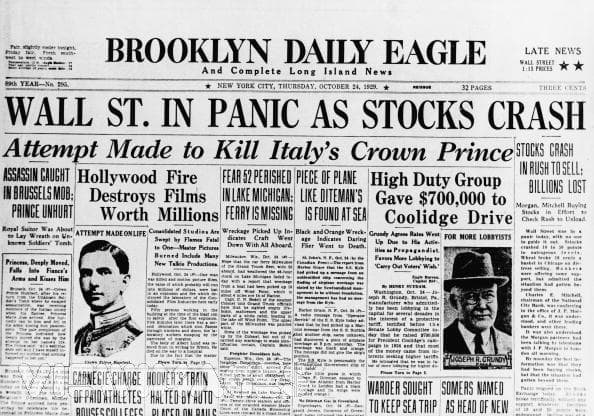
Stock prices first began to decline in late 1929 because:
company earnings declined.
several companies went bankrupt.
investors began to sell their stock.
stockbrokers stopped margin loans.
7
During the stock market crash of 1929, prices were driven down by:
investors selling stocks at a frenzied pace.
banks being forced to close.
the government intervening in the market.
companies being forced out of business.
8
The presidential election of 1928 resulted in this Republican winning in a landslide:
William Howard Taft
Warren G. Harding
Herbert Hoover
Calvin Coolidge
9
The stock market crash weakened the nation's banks because:
banks had invested their deposits in the stock market.
banks depended on their stock for operating funds.
investors no longer had money to deposit in banks.
investors could no longer afford to take loans from banks.
10
What percentage of American households owned stock by 1929:
40%
10%
20%
50%
11
In 1929, the top 5% of all American households earned 30% of all income, an example of:
a recession.
a bull market.
an uneven distribution of income.
overproduction.
12
James J. Braddock was...
of Irish descent
alive during the Depression
All of the above
a boxer