stud
bud
Sign up
Log in
Home
Library
Explore
SAT
More
Grade 8 STAAR Earth & Space (Solar System & Universe) Flashcards | StudBud
Explore
/
Grade 8 STAAR Earth & Space (Solar System & Universe)
Grade 8 STAAR Earth & Space (Solar System & Universe)
40 terms
·
StudBud Administration
·
4,874 plays
Review to help with earth and space portion of STAAR. #science #8thgrade #staar
Flashcards
40 cards
F
Practice quiz
P
Host live
L
Questions
40
Answers
1
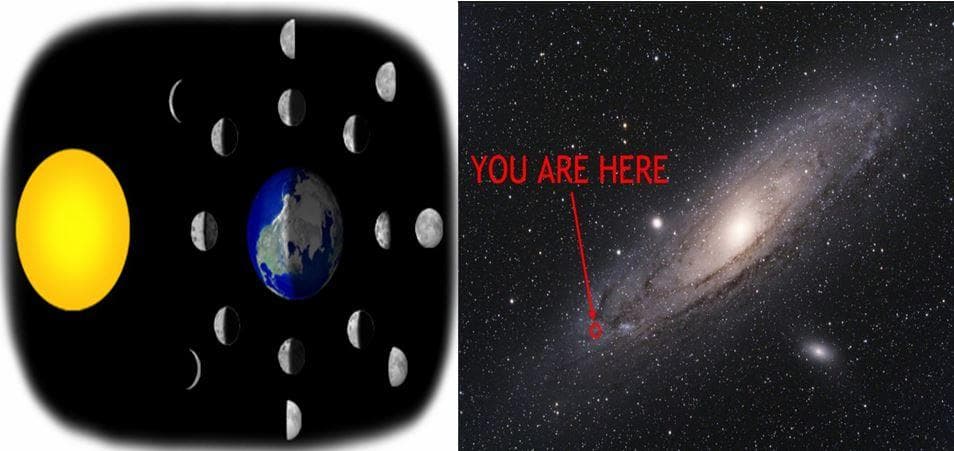
Word describing when the sunlit part of the moon is seems to be growing smaller.
Crescent
Waning
Waxing
Gibbous
2
The location of the Sun in the Milky Way.
Its not in the Milky Way
On the bottom
In the middle
Near the edge
3
Orbit of Earth around the Sun is called this.
Orbit
Tilt
Rotation
Revolution
4
Graph that shows the relationship between a star's luminosity and surface temperature.
Star Chart
Line Graph
Astrological Calendar
H-R Diagram
5
Medium-massed stars can release this at the end of their red giant stage.
Black Hole
Nebula
Planetary Nebula
Supernova
6
The distance light can travel in one year.
Kilometer
Astronomical Unit
Parsec
Light year
7
Phase (shape) of the moon that occurs when less than half the moon seems to be lit by the Sun.
Waning
Waxing
Crescent
Gibbous
8
Word describing when the sunlit part of the moon is seems to be growing larger.
Gibbous
Crescent
Waning
Waxing
9
The cause of Earth's seasons.
Rotation & Tilt
Revolution & Speed
Rotation & Revolution
Revolution & Tilt
10
The spinning of Earth on its axis is called this.
Rotation
Revolution
Orbit
Tilt
11
Phase that occurs when the entire sunlit side of the Moon can be seen from Earth.
Full moon
Solar eclipse
New moon
Lunar eclipse
12
Light years are a measure of ______________.
Time
Distance
Luminosity
Space
13
The closest star to the Earth is what?
The Sun
Sirius
Proxima Centauri
Alpha Centauri
14
Occurs when the Moon passes through Earth's shadow.
Lunar eclipse
Full moon
New moon
Solar eclipse
15
Disc-shaped galaxies that have curved arms winding out from their centers.
Elliptical galaxies
Spiral galaxies
Halo galaxies
Irregular galaxies
16
What type of star is the Sun?
Low-Mass
Main Sequence
High-Mass
Red Giant
17
The amount of Earth's tilt on its axis.
32.5 degrees
23.5 degrees
45 degrees
90 degrees
18
The approximate length of the Lunar cycle.
1 light year
1 week
1 month
365.25 days
19
Waves with the longest wavelengths.
Radio Waves
Ultraviolet Rays
Gamma Rays
Microwaves
20
The distance between the crest of one wave and the wave next to it is called ___________.
trough
amplitude
wavelength
frequency
21
Phase (shape) of the moon that occurs when more than half the moon seems to be lit by the Sun.
Crescent
Waxing
Waning
Gibbous
22
Waves with the shortest wavelengths.
Microwaves
Ultraviolet Rays
Radio Waves
Gamma Rays
23
The extremely violent end of a high-mass star; it can be brighter than entire galaxies.
Nebula
Supernova
Black Hole
Planetary Nebula
24
Type of tide that occurs when the Sun, Moon, and Earth form a 90 degree angle.
High tide
Spring tide
Neap tide
Low tide
25
Phase that occurs when the entire sunlit side of the Moon faces away from Earth.
Lunar eclipse
Solar eclipse
New moon
Full moon
26
A star that shows a redshift in the electromagnetic radiation it emits is moving _____________.
away
closer
in circles
nowhere
27
Stars begin in this large cloud of gas and dust.
Planetary Nebula
Black Hole
Nebula
Supernova
28
The cosmological theory that the universe began ~20 billion years ago in a violent explosion.
Theory of Evolution
The Big Bang Theory
String Theory
The Theory to Plate Tectonics
29
Darker portion of the shadow which causes a total eclipse.
Pendulum
Umbrella
Penumbra
Umbra
30
All of space and all the matter and energy in it.
Galaxy
Star
Universe
Solar System
31
Occurs when the Moon blocks the Sun's light from reaching Earth.
New moon
Full moon
Lunar eclipse
Solar eclipse
32
Type of tide that occurs when the Sun, Moon, and Earth are in a straight line.
High tide
Neap tide
Spring tide
Low tide
33
Circular/oval-shaped galaxies.
Spiral galaxies
Halo galaxies
Elliptical galaxies
Irregular galaxies
34
A luminous ball of gas which is undergoing nuclear fusion and is held together by gravity.
Globular Cluster
Nebula
Star
Comet
35
Lighter portion of the shadow which causes only a partial eclipse.
Pendulum
Umbrella
Penumbra
Umbra
36
The gravitational pull of the moon causes __________ .
Tides
Earth's rotation
Global winds
Eclipses
37
Galaxies without a definable shape.
Irregular galaxies
Halo galaxies
Elliptical galaxies
Spiral galaxies
38
The spiral galaxy our solar system is located in.
The Andromeda Galaxy
The Crab Nebula
The Magellanic Cloud
The Milky Way
39
Type of tide that occurs when the water reaches its highest level.
Neap tide
High tide
Spring tide
Low tide
40
The entire range of electromagnetic waves.
Emission Spectrum
Spectrograph
Absorption Spectrum
Electromagnetic Spectrum