stud
bud
Sign up
Log in
Home
Library
Explore
SAT
More
Faults and Plate Boundaries Review Flashcards | StudBud
Explore
/
Faults and Plate Boundaries Review
Faults and Plate Boundaries Review
15 terms
·
StudBud Administration
·
767 plays
Quiz Review.
Flashcards
15 cards
F
Practice quiz
P
Host live
L
Questions
15
Answers
1
When 2 plates slide past each other, a _________fault forms.
Strike-Slip
Transform
Reverse
San Andreas
2
When the hanging wall slips down below the foot wall, it is called a ________fault.
Convergent
Strike-Slip
Normal
Reverse
3
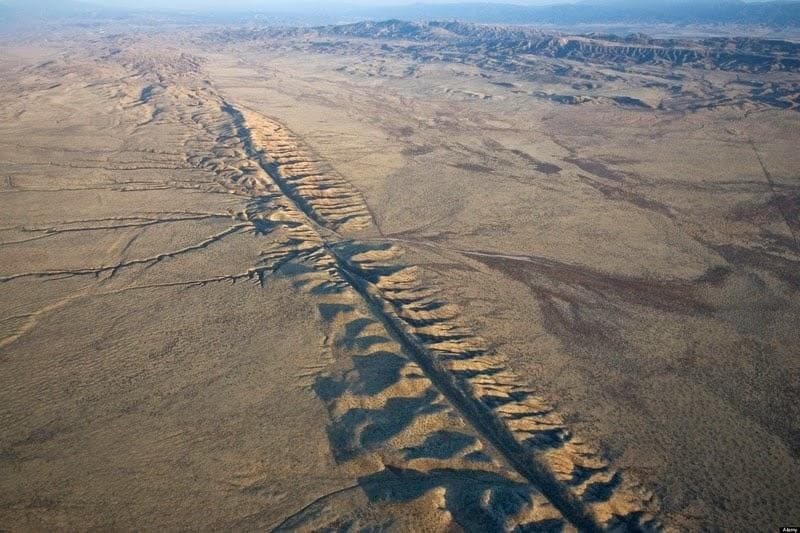
The San Andreas Fault occurs at a _________ boundary and is an example of a ________fault.
convergent, reverse
convergent, normal
transform, strike-slip
divergent, normal
4
Normal faults occur along ____________plate boundaries.
Subduction
Convergent
Divergent
Transform
5
When the hanging wall slides up over the foot wall, this is called a _________fault.
Divergent
Normal
Reverse
Strike-Slip
6
__________occurs at convergent plate boundaries in which an oceanic plate goes under another.
Earthquakes
Volcanoes
Mountain Ranges
Subduction
7
A crack in the earth's surface caused by stress put on rock is called a_________.
Lithospheric Plate
Fault
Plate Boundary
Tension
8
Normal faults are caused by ____________stress.
Compression
Tension
Shear
Pressure
9
When 2 plates collide, this is called a __________plate boundary.
Divergent
Reverse
Convergent
Strike-Slip
10
Strike-Slip faults occur along _____________plate boundaries.
Convergent
Transform
Divergent
Subduction
11
When tectonic plates slide past each other, this is called a ________plate boundary.
Strike-Slip
Divergent
Convergent
Transform
12
Reverse faults occur along ______________plate boundaries.
Subduction
Transform
Divergent
Convergent
13
When 2 lithospheric plates move apart, this is called a _________plate boundary.
Reverse
Normal
Divergent
Convergent
14
Transform faults are caused by ____________stress.
Tensional
Compressional
Shearing
Pressure
15
Reverse faults are caused by ____________stress.
Shearing
Compressional
Pressure
Tensional