stud
bud
Sign up
Log in
Home
Library
Explore
SAT
More
Multi-step Equations With Fractions and Decimals Flashcards | StudBud
Explore
/
Multi-step Equations With Fractions and Decimals
Multi-step Equations With Fractions and Decimals
14 terms
·
StudBud Administration
·
2,126 plays
In-depth questions about multi-step equations with fractions and decimals
Flashcards
14 cards
F
Practice quiz
P
Host live
L
Questions
14
Answers
1
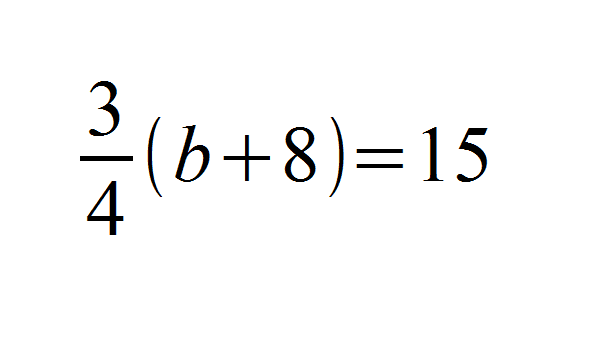
Now we have this. What do we do last?
Subtract 8 from both sides to get b = 12
Add b + 8
Subtract 20 from 8 to get -12
Add -8 to all three terms
2
What type of terms are 3 and 2?
Negative
Constants
Like Terms
Variables
3
What are the terms of the equation?
¼x + 3 and 2
¼x, 3, and 2
¼ + 3 and 2
¼x, +, 3, =, and 2
4
15
/
1
•
4
/
3
on the right simplies to what, once reduced?
19/3
60/3
Can't be simplified
20
5
Let's multiply both sides by 4. What will we have?
x = 4
x = -5
x • 4 = -4
x = -4
6
What's going on here?
¾ times (b+8)
8 more than b is a quantity
Multiplying by ¾ distributes over two terms
All true statements
7
Let's multiply both sides by 4/3, the recipical of ¾. What do we have now?
4/3 b + 8 = 20
Just b + 8 on the left
15/1 • 4/3 on the right
b + 6 = 20
8
What are the sides of equation?
¼x and 3 = 2
¼x + 3 and 2
¼x, 3, and 2
¼ + 3 and 2
9
We subtracted 3 from both sides to get this. What next?
Subtract ¼ from both sides.
Multiply both sides by 4
Multiply both sides by the reciprocal of ¼.
Multipy ¼x by 4
10
What would be a good first step in solving this equation?
Subtract ¼ from both sides
Multiply each side by 4
Subtract 3 from each side
Add ¼x and 3
11
What do we get if we multiply both sides by 4?
1x + 12 = 8
¼x + 12 = 8
¼x + 7 = 6
1x + 3 = 8
12
What do we get if we subtract 3 from both sides?
¼x = 5
¼x + 3 = -1
¼x + 3 = -1
¼x = -1
13
Why can't we combine ¼x + 3 into one term?
Because they're not on the same side of the equation
Because you can't add fractions without like denominators
Because ¼x and 3 are unlike terms
You can. ¼x + 3 = 4/4 x
14
We can distribute ¾ over (b + 8), but is there an easier way to start solving for b?
Multipy both sides by 4
Subtract ¾ from both sides.
Add b + 8 first.
Multiply both sides by 4/3, the reciprocal of ¾